The Comrades
417 Squadron and beyond
No fighter squadron's story belongs to one man alone. This chapter is dedicated to the men who trained with, flew alongside, and served under Johnnie Koplitz — and to the families who have kept their memory alive.
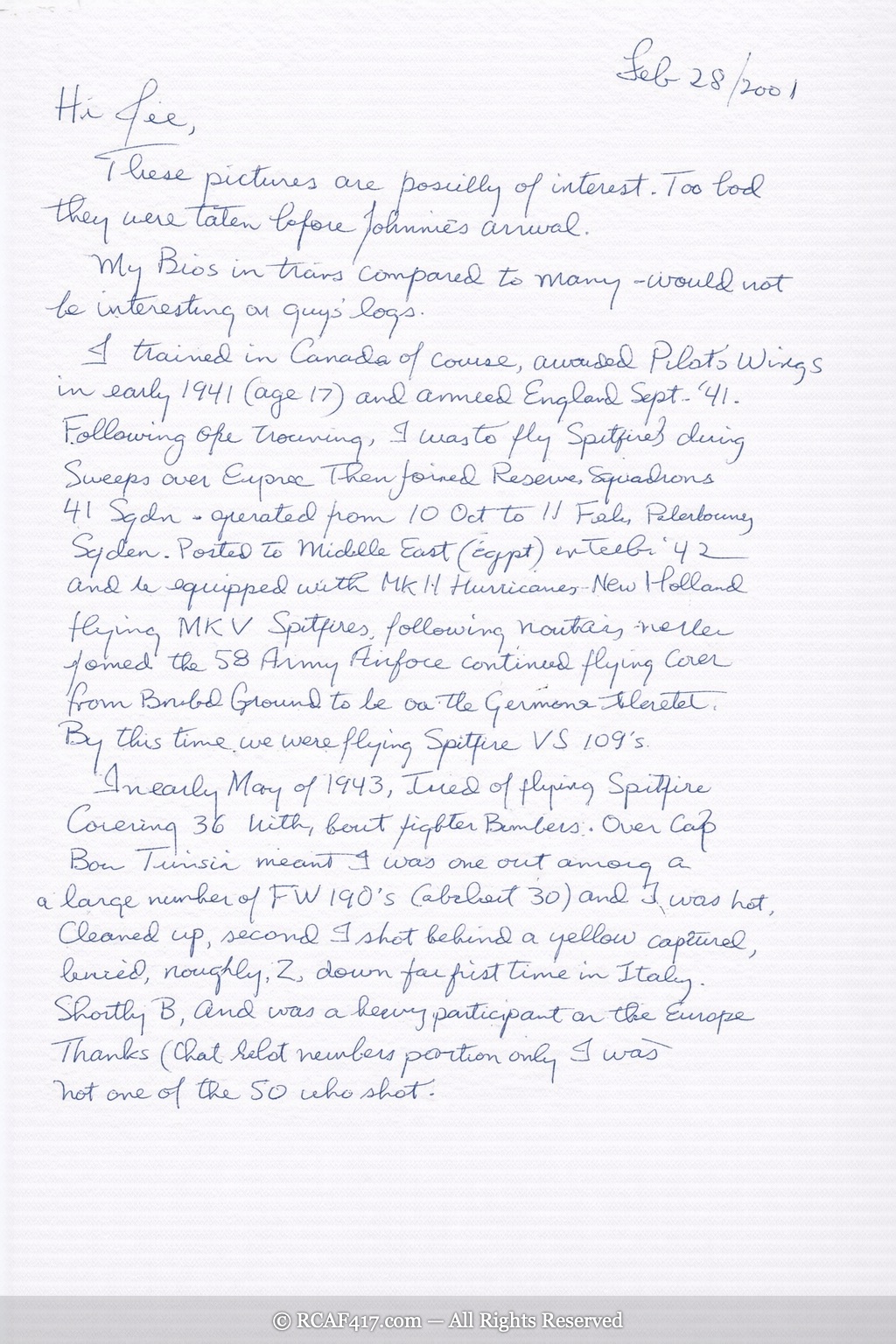
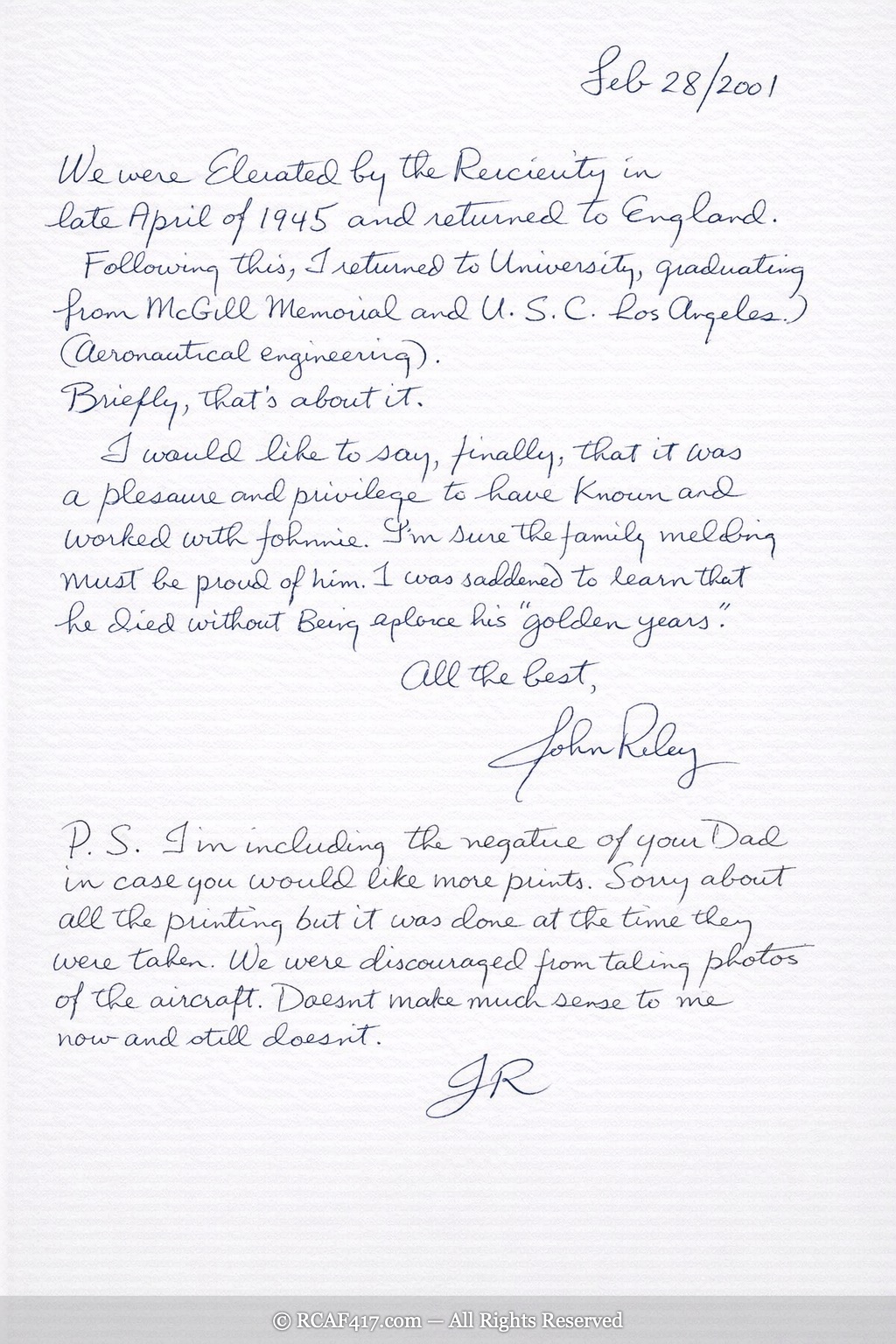
John Riley
John Riley trained with Koplitz in Canada in 1941 and flew with him in 417 Squadron. He took the now-famous portrait photograph of Johnnie during that training — see it in Chapter Two: The Volunteer. Riley was later shot down over Cap Bon, Tunisia, by Messerschmitt Bf 109s and spent time as a prisoner of war — held, the family understands, at Stalag Luft III, the camp of the famous "Great Escape" of March 1944. Of the 76 men who broke out through the tunnel, the Gestapo executed 50 after they were recaptured; Riley was one of the fortunate ones who was not among them. Decades later, on February 28, 2001, Riley wrote to the Koplitz family, enclosing the original negative of that portrait.
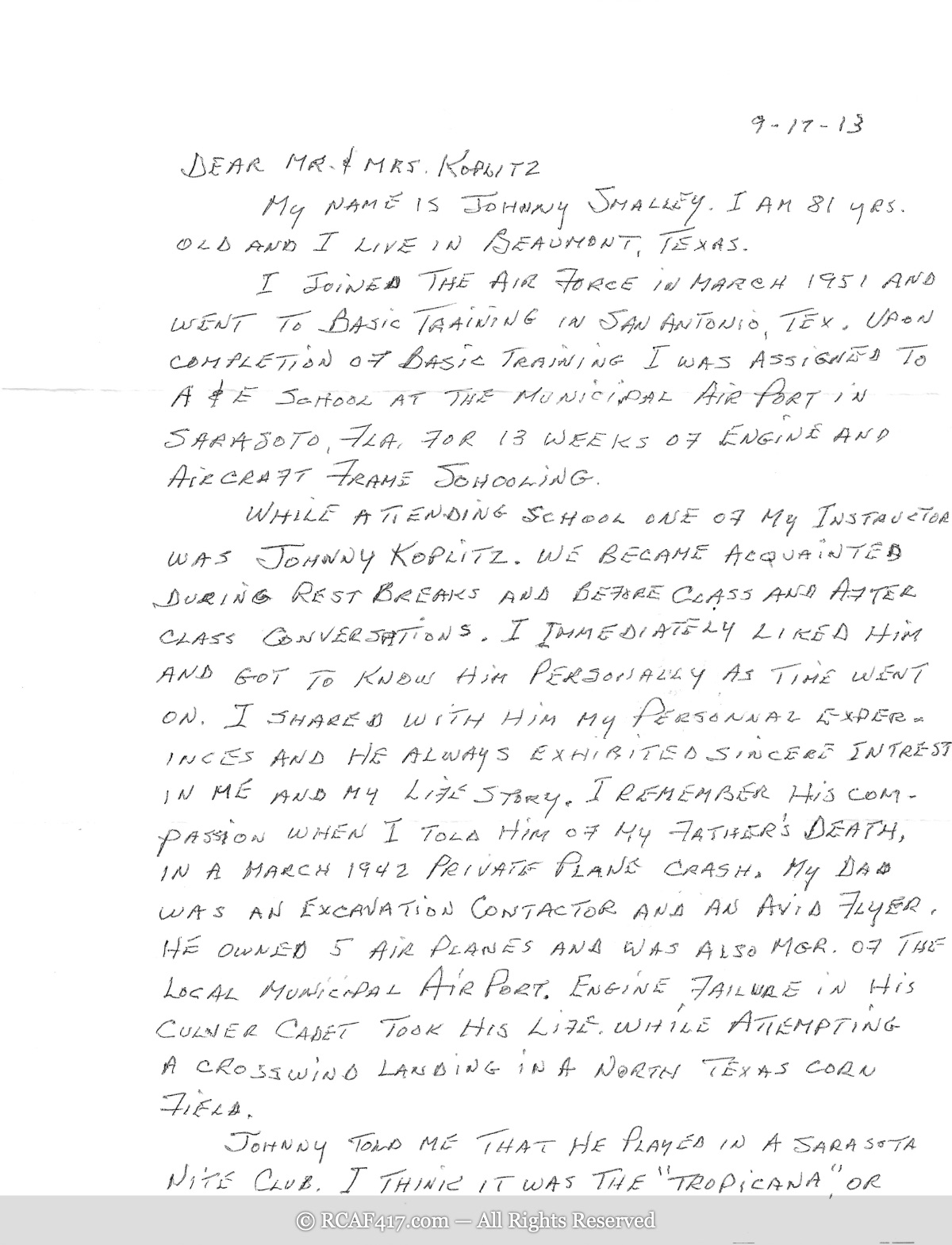
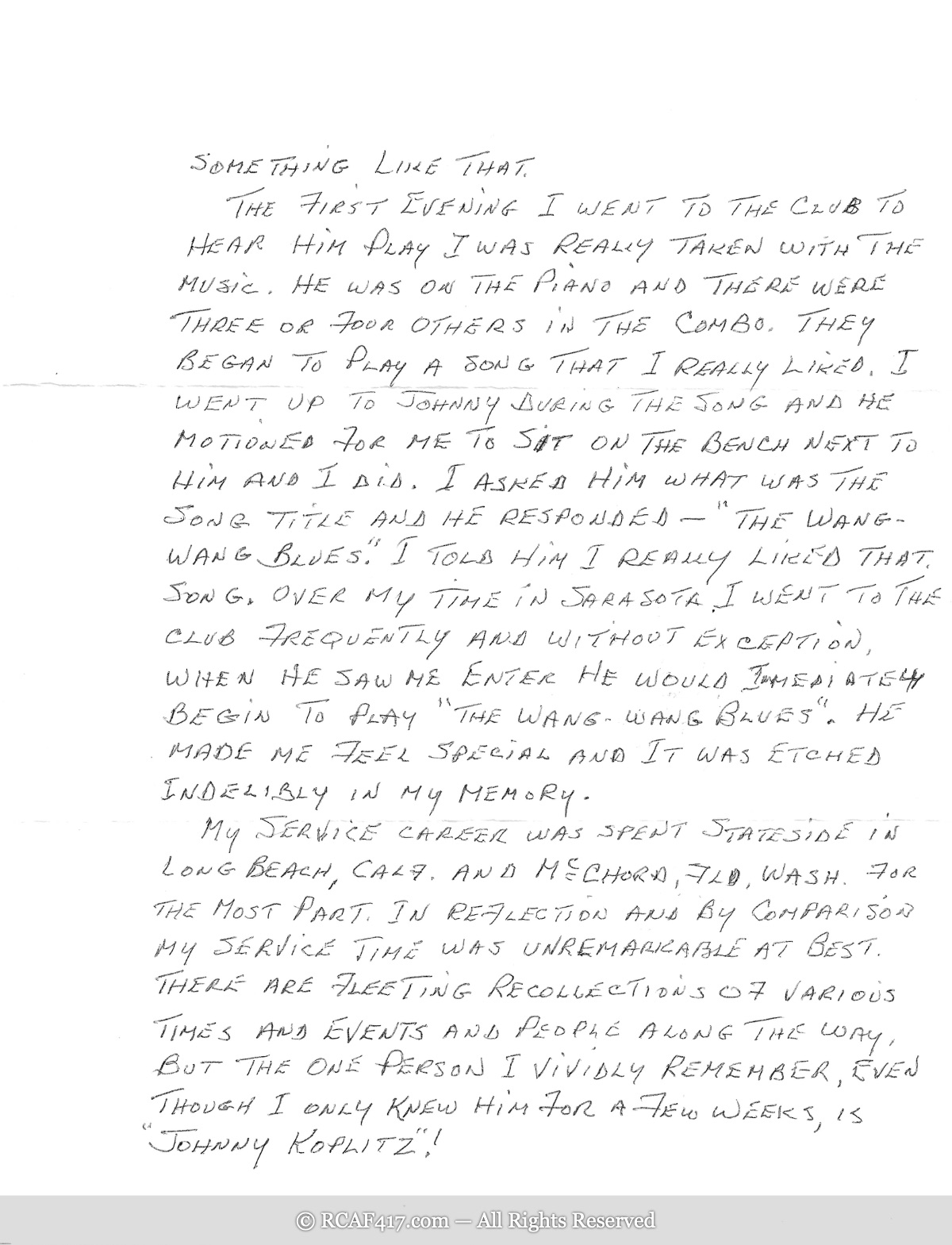
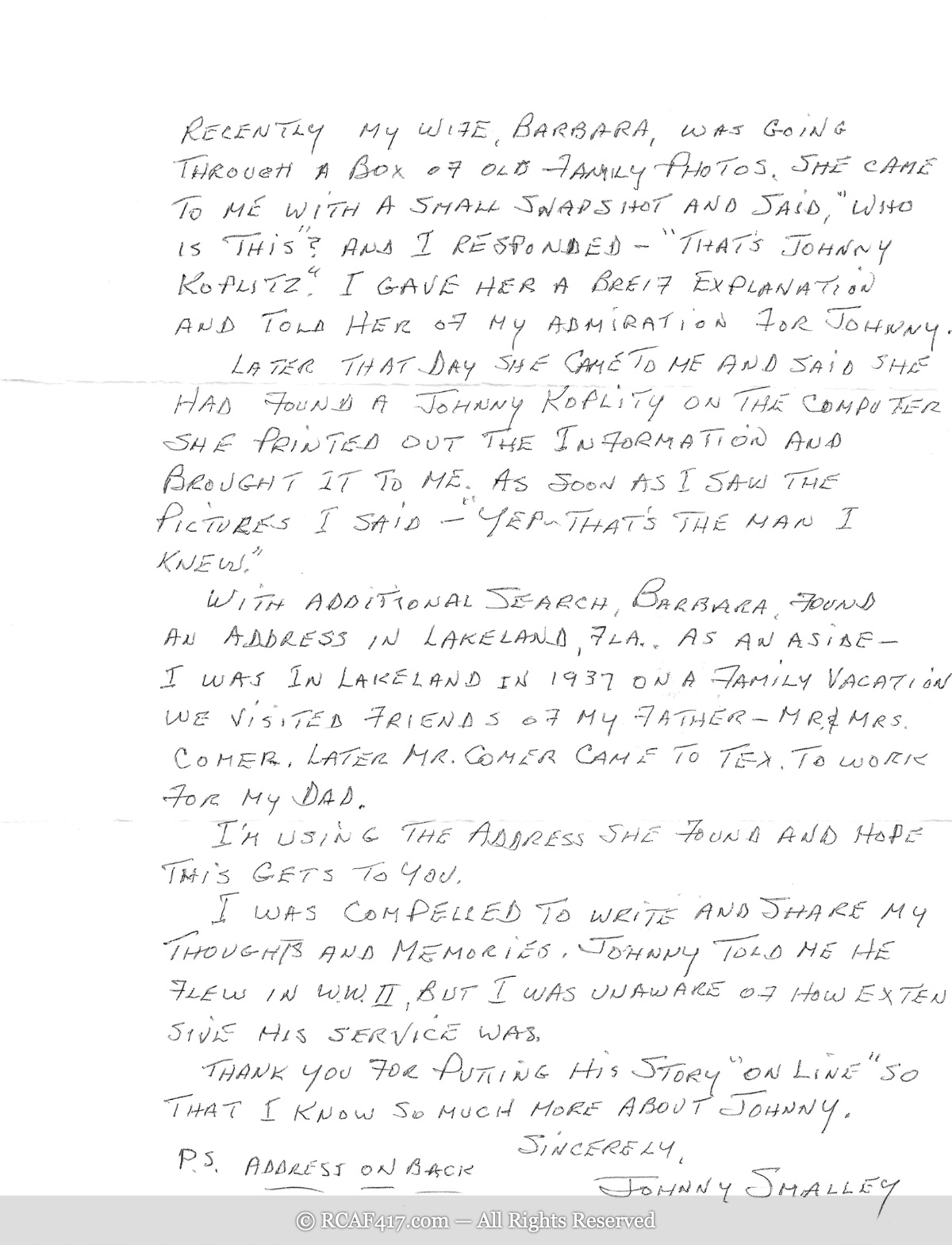
Johnny Smalley
Not a wartime comrade but a postwar one: Johnny Smalley was a student of Koplitz's at the Sarasota A&E School in 1951 (see the photograph, which Smalley himself took and identified on the back of the print, in Chapter Eight). More than sixty years later, on September 17, 2013, Smalley wrote to the Koplitz family out of the blue to share what he remembered.
Guy A. Wood Jr.
A fellow 417 Squadron pilot whose family generously donated a wartime scrapbook to this archive — one of several scrapbooks from 417 Squadron veterans' families that have helped piece this story together.
P/O "Doug" Bruce and P/O "Jack" Evans
Doug Bruce and Jack Evans appear together in photographs from the squadron's time in the desert; Evans is identified as the squadron's Commanding Officer in at least one image in the collection.
F/L Stuart Allan Corbett
For a long time the pilot in the solo Spitfire-nose portrait in Chapter Three was left unnamed, possibly Koplitz himself. A second scan of that same photograph, together with his own RCAF Certificate of Service, has since identified him as Flight Lieutenant Stuart Allan Corbett, service number CAN J.16541 — active service from December 18, 1940 to his honourable release on September 25, 1945, with the 1939-45 Star, the Africa Star and Rosette, and the Canadian Volunteer Service Medal and Clasp among his decorations. See the full certificate alongside the photograph in Chapter Three.
Air Marshal Harold "Gus" Edwards
Photographs in the archive record a visit by Air Marshal Harold "Gus" Edwards to 417 Squadron — a reminder of how closely the squadron's exploits were followed up the RCAF's chain of command.
S/Sgt. Quentin Kaiser
From Koplitz's later USAAF service, Quentin Kaiser was a radio-gunner with the 489th Bombardment Squadron — Koplitz's own squadron — named in the family's account of the Battle of the Brenner in Chapter Five, where his portrait now appears alongside the story.
This chapter will grow as more of the family archive — roughly 1,000 photographs and 300 pages of service records in total — is scanned and identified. If you served with, or are related to someone who served with, 417 Squadron or the 340th Bomb Group's 489th Squadron, the family would welcome hearing from you.