Koplitz arrived in Egypt in April 1942, into a desert air war fought over vast distances of
open sand between the Allies and Rommel's Afrika Korps. On October 1, 1942, he was promoted
Flight Sergeant, and a week later, on October 8, 1942, he joined 417 Squadron — "City of
Windsor" — flying the Supermarine Spitfire, first the Mark V and later the Mark IX.
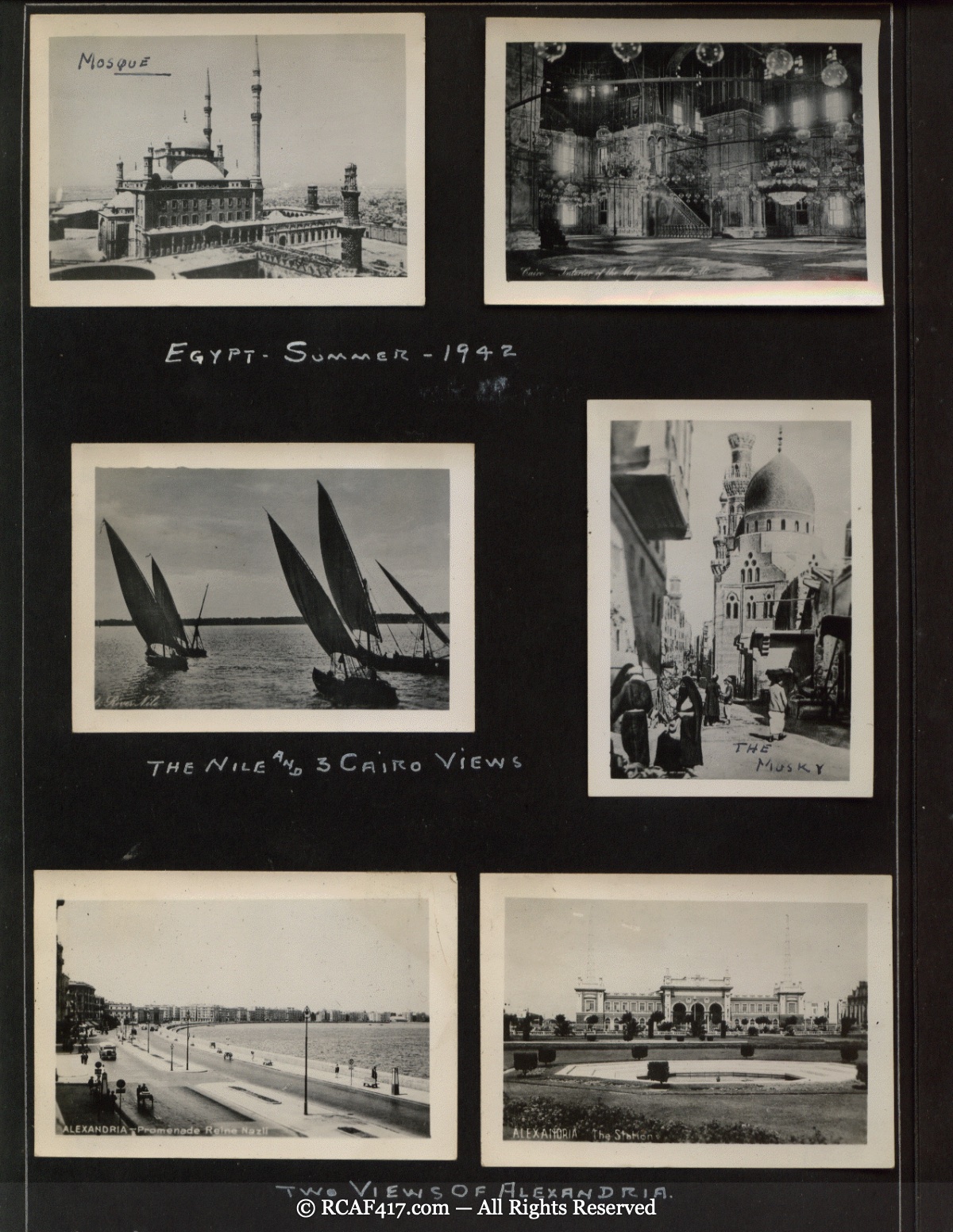
A page of postcards headed "Egypt – Summer – 1942": the Mohamed Ali Mosque at the Cairo
Citadel ("Mosque"); its illuminated interior; Nile sailing dhows with three further Cairo
views, including the Musky bazaar district ("The Musky"); and two views of Alexandria, the
Promenade Reine Nazli and the railway station. These are printed commercial postcards
rather than personal snapshots — likely bought as souvenirs while on leave in Cairo and
Alexandria — but they're dated to the very summer Koplitz arrived in Egypt. Album page
courtesy of Guy A. Wood Jr.
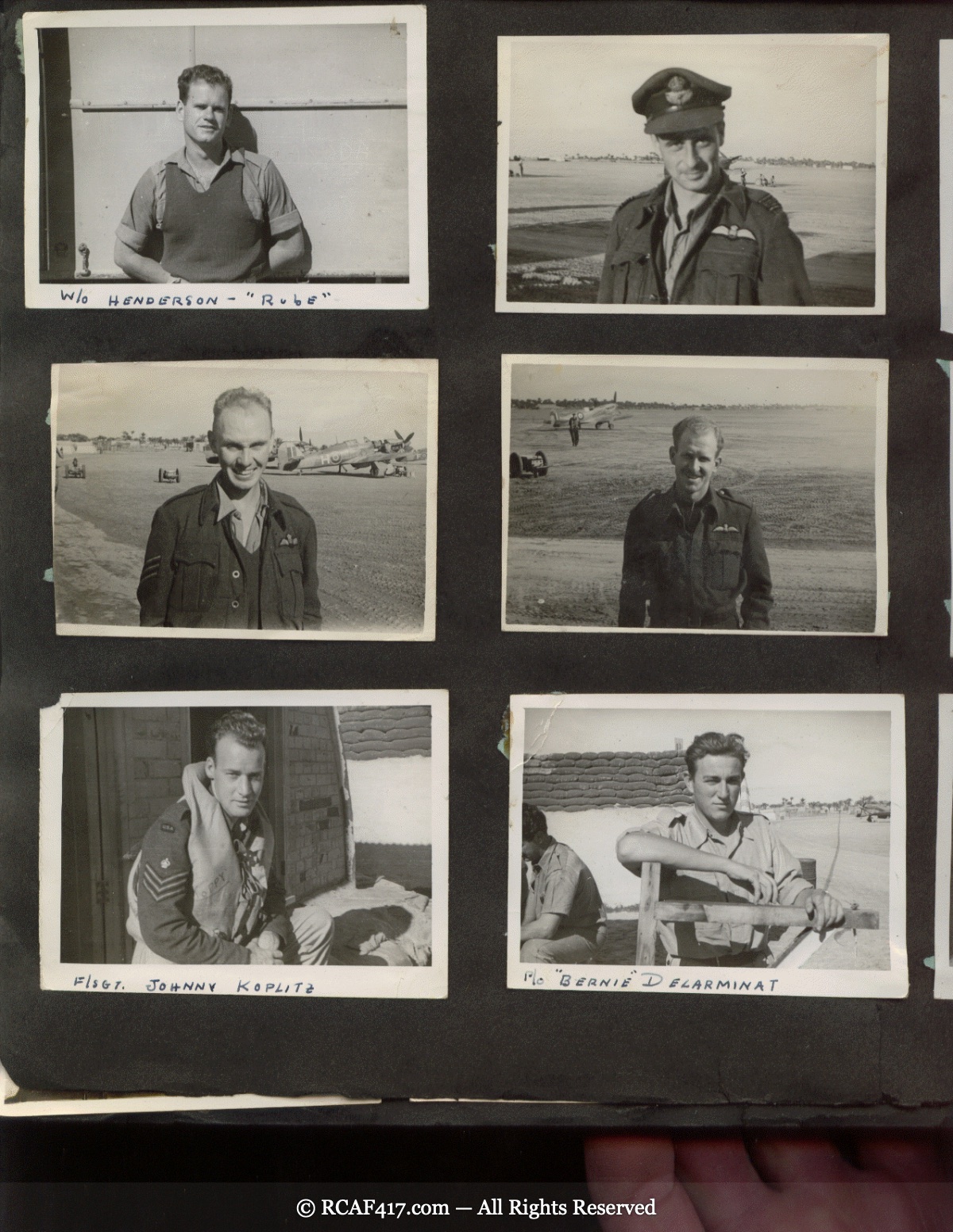
A page of individual portraits from Egypt, each named on the print: W/O Henderson ("Rube"),
two further portraits, F/Sgt. Johnny Koplitz, and P/O "Bernie" Delarminat.
The Koplitz portrait is a confirmed, named photograph of him in the desert — a firmer
identification than the unnamed solo Spitfire-nose portrait below, which still can't be
confirmed as him. (An earlier photo elsewhere in this collection rendered the same surname
as "D'Earminat"; this handwritten caption spells it "Delarminat.") Album page courtesy of
Guy A. Wood Jr.
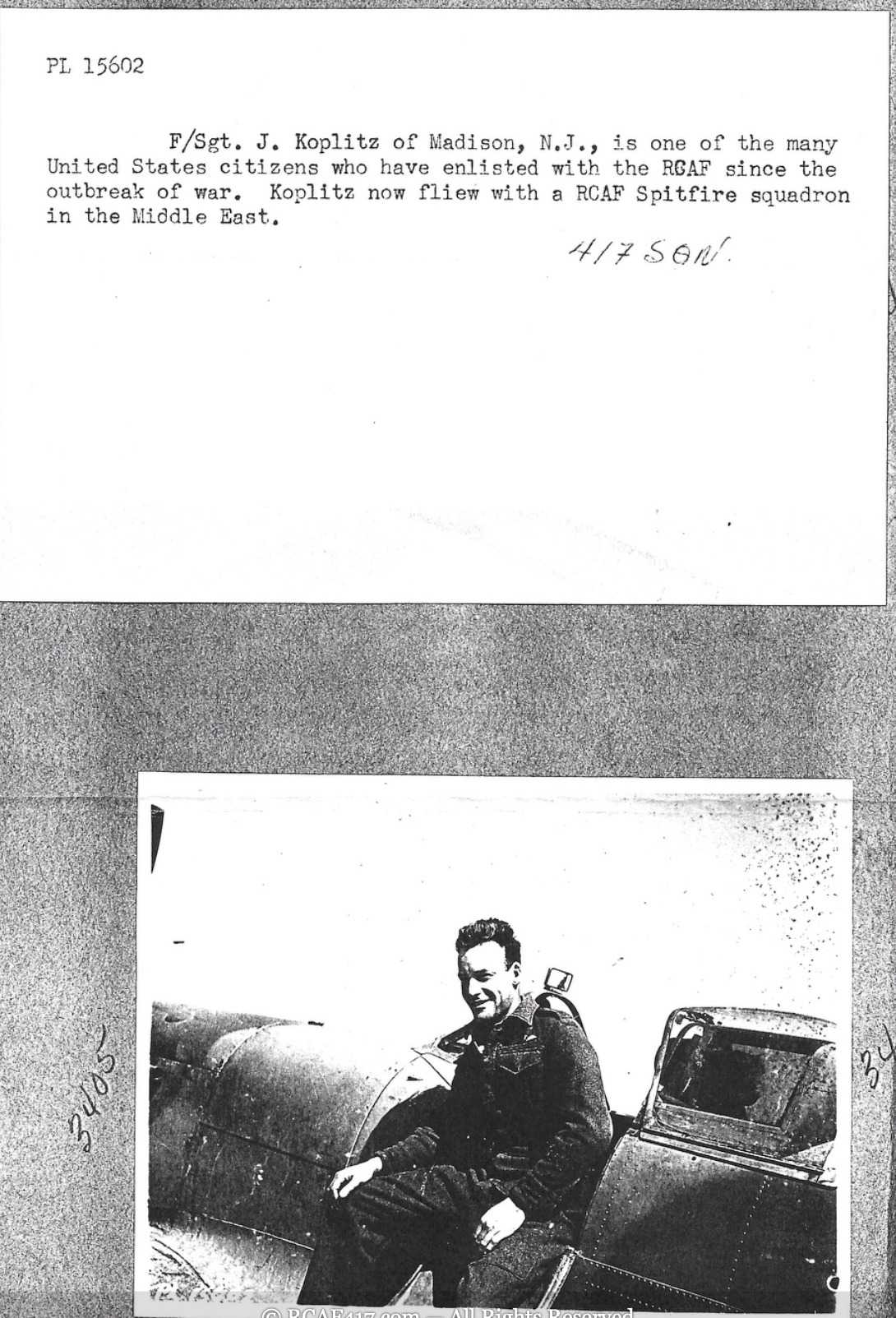
An official wartime press-service photograph, captioned on the original release sheet:
"F/Sgt. J. Koplitz of Madison, N.J., is one of the many United States citizens who have
enlisted with the RCAF since the outbreak of war. Koplitz now flew with a RCAF Spitfire
squadron in the Middle East" (negative no. PL 15602; annotated by hand "417 Sqn."). Koplitz
sits on the wing root beside his Spitfire's cockpit — a second, independently confirmed
photograph of him in the desert, distinct from the album-page portrait above and from the
unnamed pilot on a Spitfire's nose below.
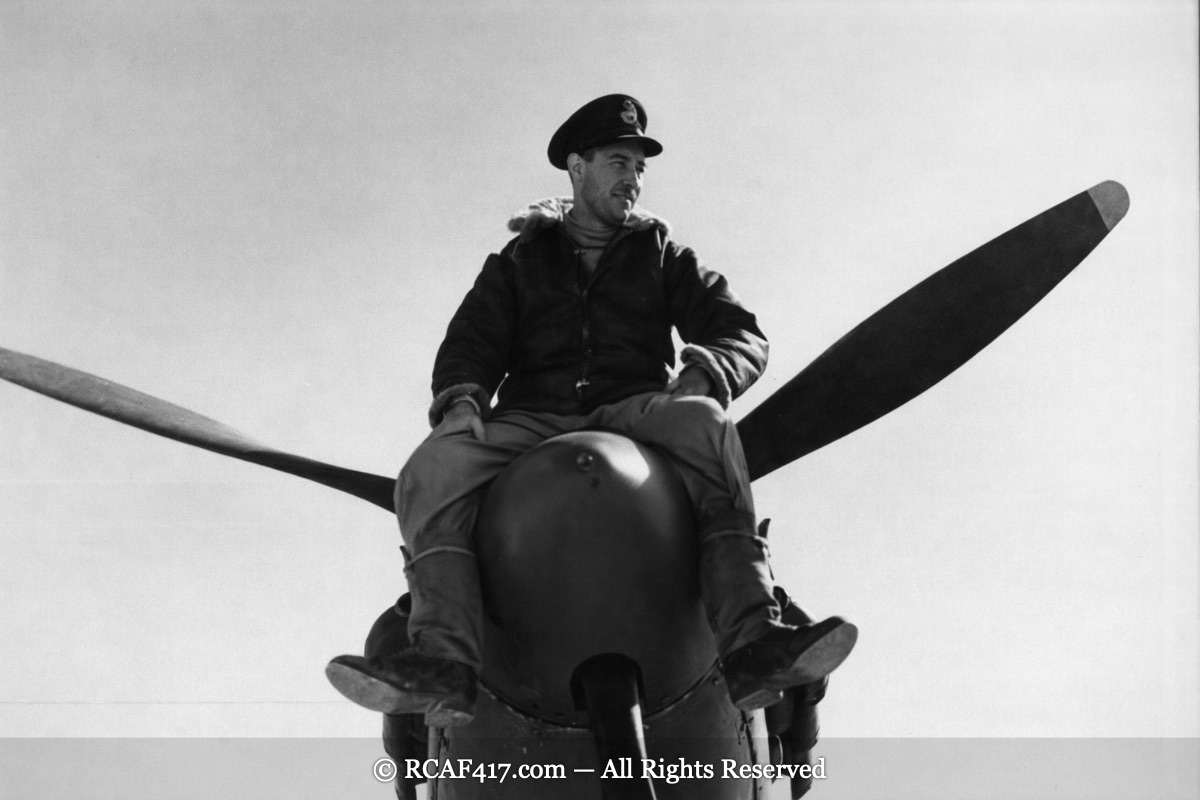
A 417 Squadron pilot posed on the nose of his Spitfire — a classic wartime portrait style,
and one of the rare surviving Spitfire photographs from the squadron's time in the desert,
since cameras were routinely confiscated and photographs of the aircraft destroyed under
wartime security rules. This print itself carries no name, but a second, uncropped scan of
the same photograph arrived filed under the name F/O Stuart Allan Corbett —
not Koplitz, as had been an open question here for some time. The identification is backed
up by Corbett's own RCAF Certificate of Service, below, so this is now a confirmed
identification rather than a filename guess.
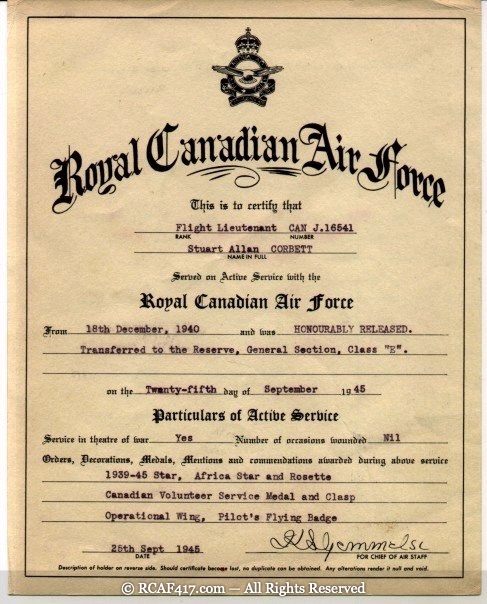
Corbett's own RCAF Certificate of Service, confirming his identity as the pilot above: Flight
Lieutenant Stuart Allan Corbett, service number CAN J.16541, served on active service with
the RCAF from December 18, 1940, honourably released and transferred to the Reserve on
September 25, 1945. His decorations include the 1939-45 Star, the Africa Star and Rosette,
and the Canadian Volunteer Service Medal and Clasp, along with his Operational Wing and
Pilot's Flying Badge — a service record that runs roughly parallel to Koplitz's own, and
squarely through the same desert campaign.
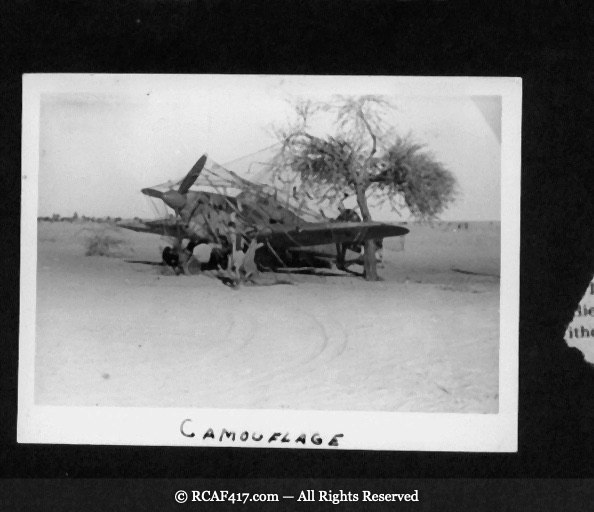
A Spitfire disguised under netting and brush at a desert airfield, captioned simply
"Camouflage" on the print — a reminder of how exposed and vulnerable aircraft were on the
open desert airfields the squadron flew from.
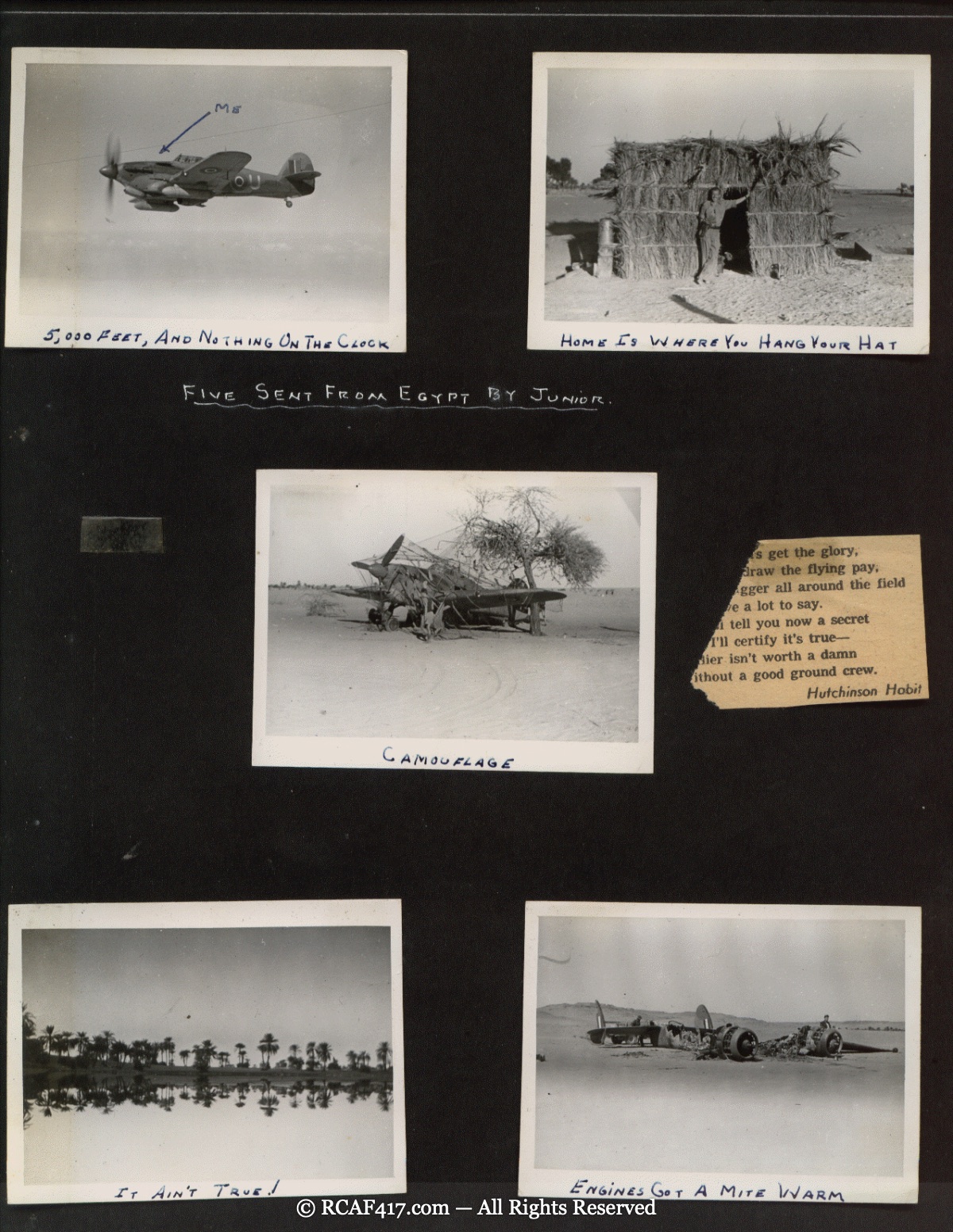
Five more snapshots, headed on the album page "Five sent from Egypt by Junior": a
single-engine fighter in flight, likely a Hurricane — consistent with the squadron's
aircraft during this period — marked "5,000 Feet, and Nothing on the Clock"; a reed-and-mud
shelter, "Home Is Where You Hang Your Hat"; a wrecked, camouflage-draped aircraft under a
tree, simply "Camouflage" (a different photo from the intact camouflaged Spitfire above, not
a duplicate); a clipped verse about ground crew credited to "Hutchinson Hobit"; a palm-lined
waterway, "It Ain't True!"; and a badly damaged twin-engine aircraft, "Engines Got a Mite
Warm." Album page courtesy of Guy A. Wood Jr.
From Egyptian airfields, 417 Squadron flew in defense of the Suez Canal — the strategic
chokepoint the entire North African campaign turned on — and across Egypt, Libya, and Tunisia
as the front moved west. Just over two months after joining the squadron, on December 20 or
21, 1942, Koplitz was commissioned Pilot Officer, an appointment made by King George VI.
Two V-mail letters from this same period, sent four days apart, capture Koplitz's own account
of the events leading up to his commission and the first mention of his eventual transfer to
the USAAF.
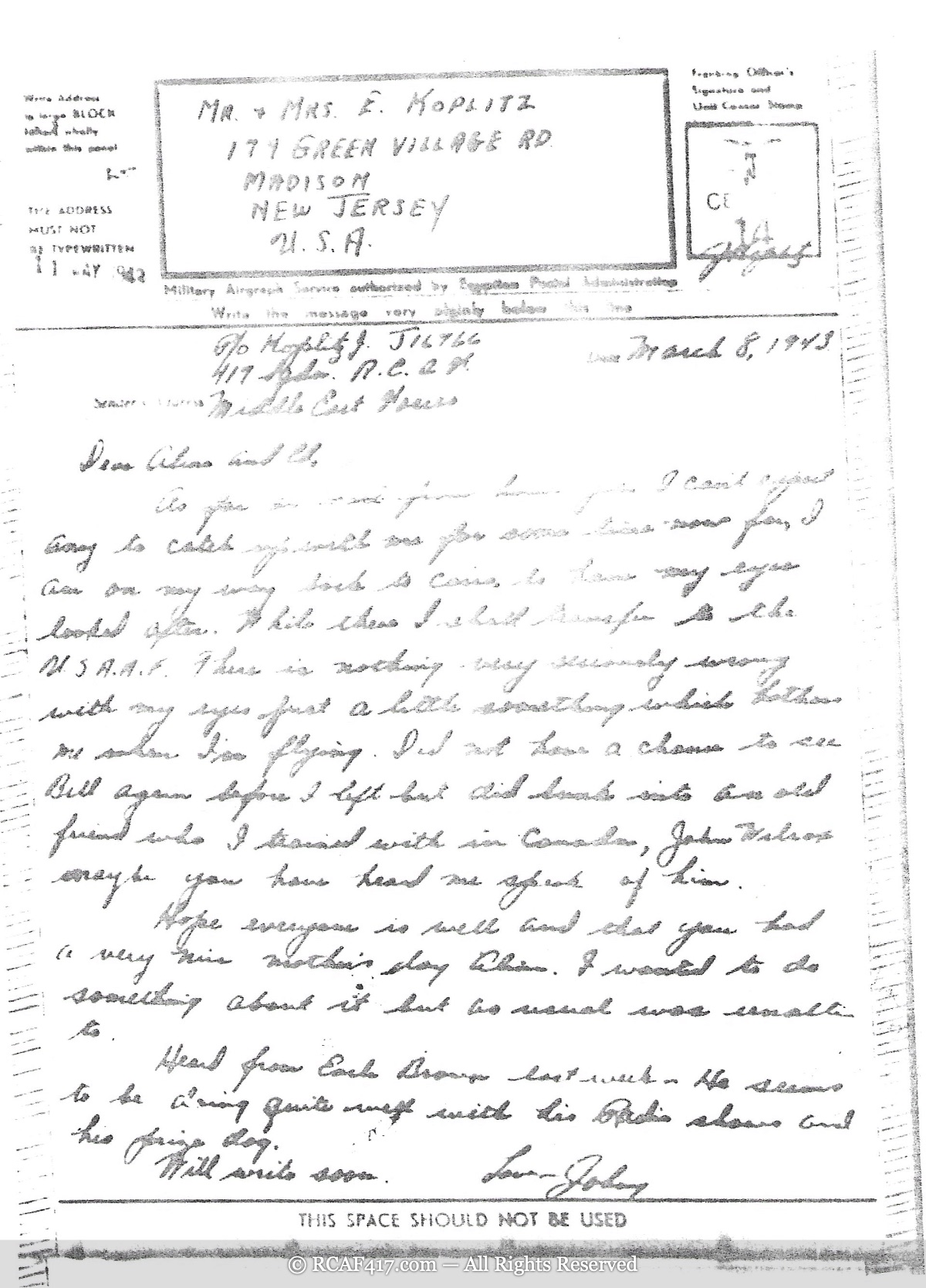
A V-mail letter dated March 8, 1943, sent from "417 Sqdn., R.C.A.F., Middle East Forces" to
"Mr. & Mrs. E. Koplitz" in Madison, New Jersey. He writes that he's on his way back to
Cairo "to have my eyes looked after," adding "there is nothing very seriously wrong with my
eyes, just a little something which bothers me when I'm flying" — and that while there, "I
shall transfer to the U.S.A.A.F.," the earliest mention of the coming move to American service
found in the family archive so far. He mentions missing a chance to see "Bill" again before
leaving — almost certainly the same Bill Livesey/Levesey he'd catch up with in Cairo a few
months later, per the July 3, 1943 letter in
Chapter Four — but running into an old
Canada-training friend, whose name is hard to make out in cursive but reads as "John
Nelson[?]." He also mentions hearing from "Jack Brown" and his radio show and prize dog. The
salutation, "Dear Aline and Ed," addresses the same two names as the letter below; it's
presented here without guessing at exactly how they were related to Johnny, beyond that they
shared the family's Madison, New Jersey address.
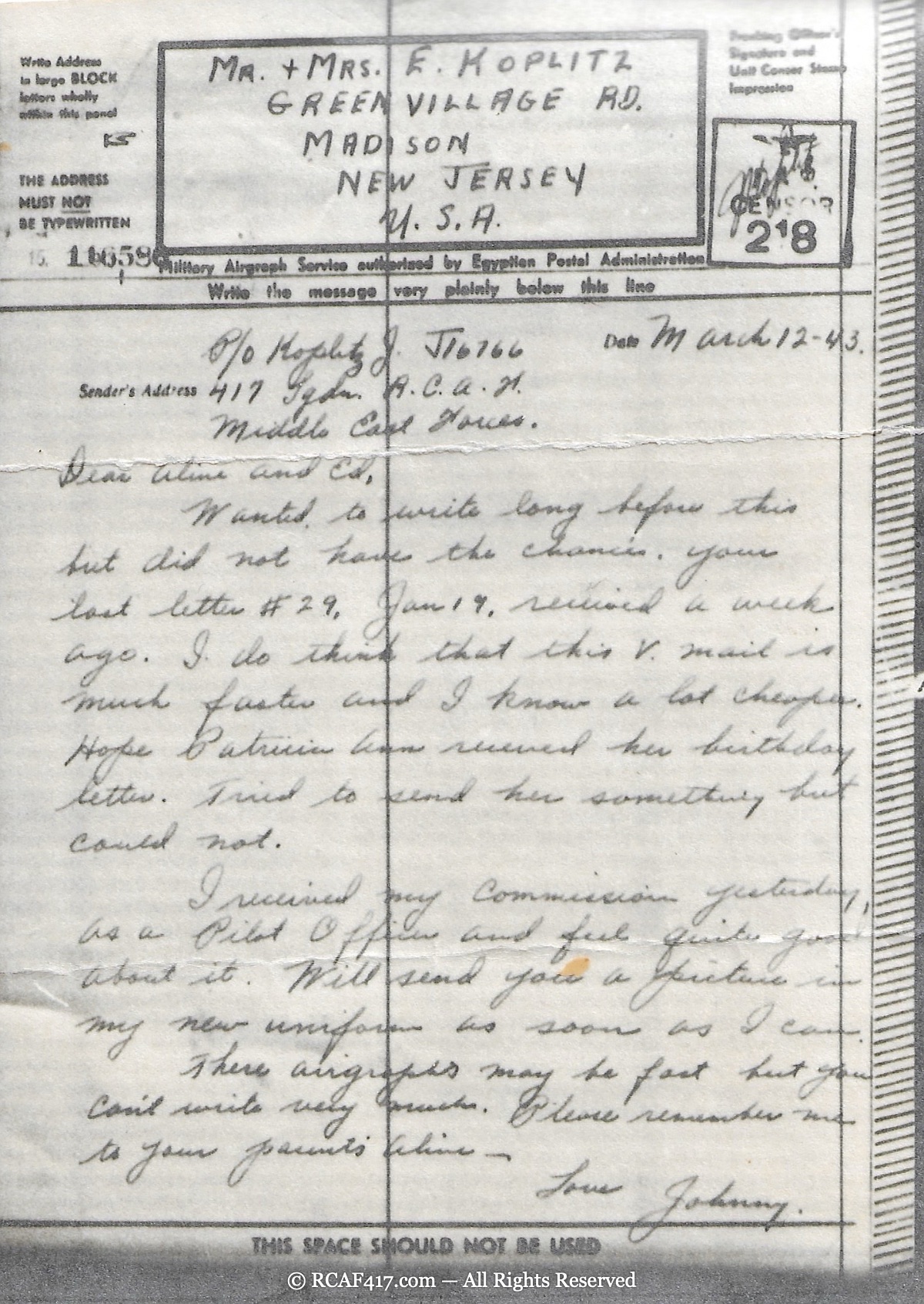
Four days later, a second V-mail letter, dated March 12, 1943, delivers the news directly:
"I received my Commission yesterday, as a Pilot Officer and feel quite good about it. Will
send you a picture in my new uniform as soon as I can." He also mentions a birthday letter for
"Patricia" and asks to "remember me to your parents Aline" — which, read alongside the "Aline
and Ed" salutation and the "Mr. & Mrs. E. Koplitz" address on both letters, suggests Aline
and Ed were a sister-in-law and brother rather than his parents, with Aline's own family being
a separate household — presented here as a reasonable reading rather than a confirmed one. He
signs off noting the format's tradeoff plainly: "These airgraphs may be fast but you can't
write very much."
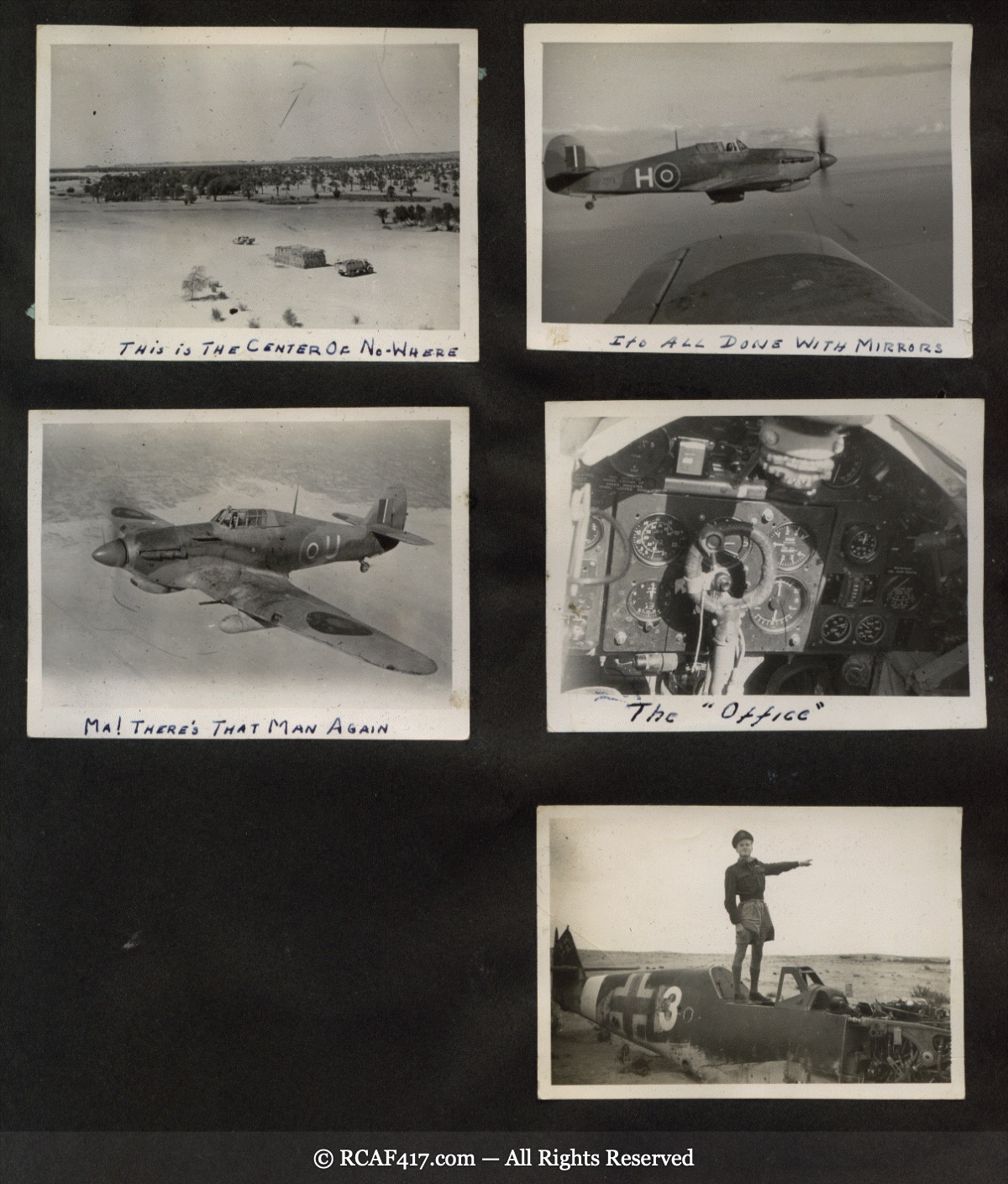
A page of Hurricane fighter photographs from the desert: an aerial view of an oasis
settlement, wryly captioned "This Is the Center of No-Where"; two Hawker Hurricanes in
flight, coded "HO" ("It's All Done With Mirrors") and "U" ("Ma! There's That Man Again"); a
cockpit instrument panel, "The Office"; and an airman standing atop a wrecked, captured
enemy aircraft marked with a large "3." The code letters visible on these Hurricanes don't
match 417 Squadron's own "AN" code (see the Squadron
History page), so these particular aircraft likely belonged to a different unit —
possibly one the album's compiler flew or served with separately from his time documenting
417 Squadron. 417 Squadron itself flew Hurricanes only briefly, from September 1942 to
January 1943, before converting fully to Spitfires. Album page courtesy of Guy A. Wood Jr.
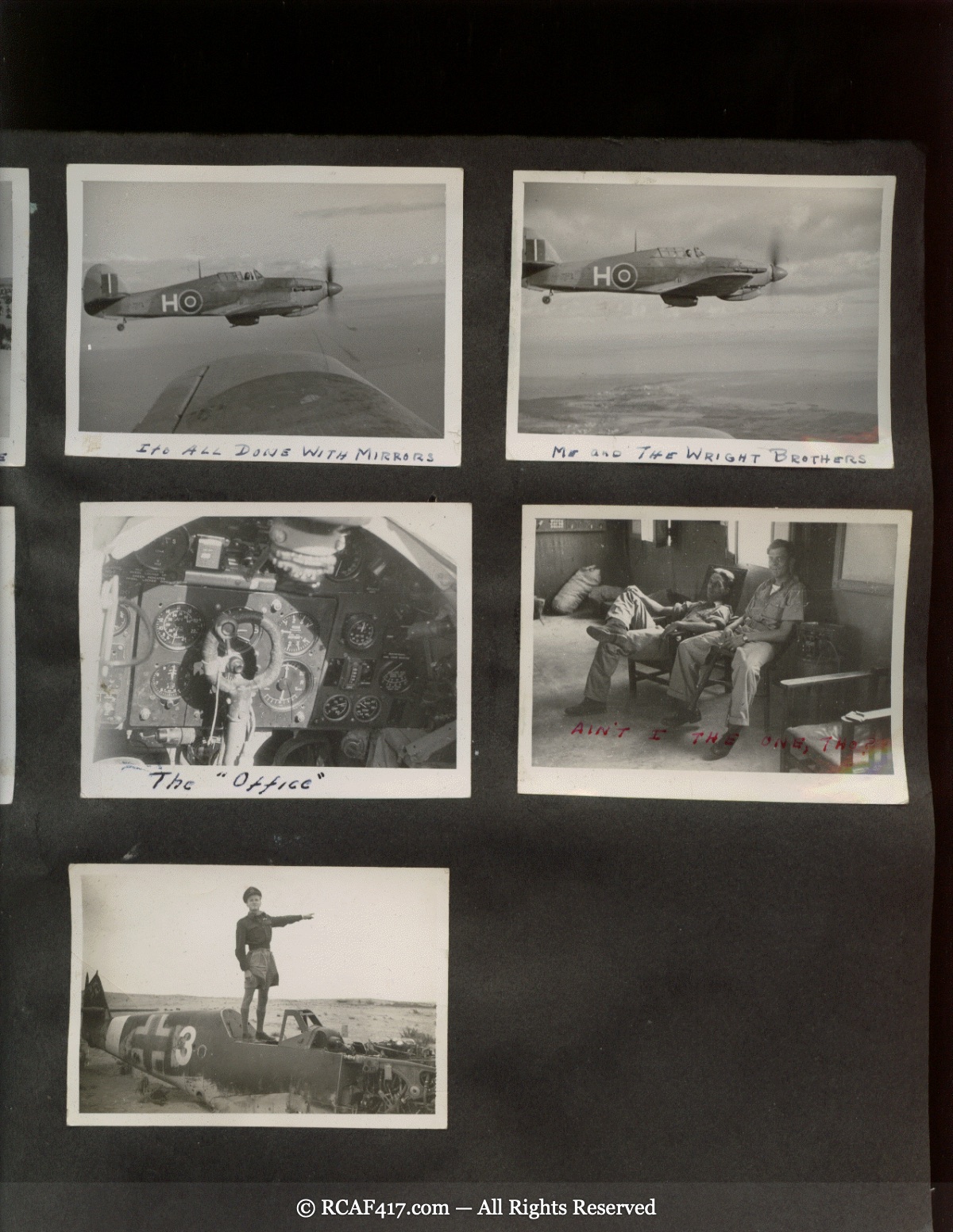
A companion page reusing the "It's All Done With Mirrors" Hurricane, "The Office" cockpit,
and captured-wreck photos from the page above, alongside two new images: a third Hurricane
in flight, captioned "Me and the Wright Brothers," and two airmen relaxing off duty, one
reclining with his feet up, labeled "Ain't I the One, Tho?" Album page courtesy of Guy A.
Wood Jr.
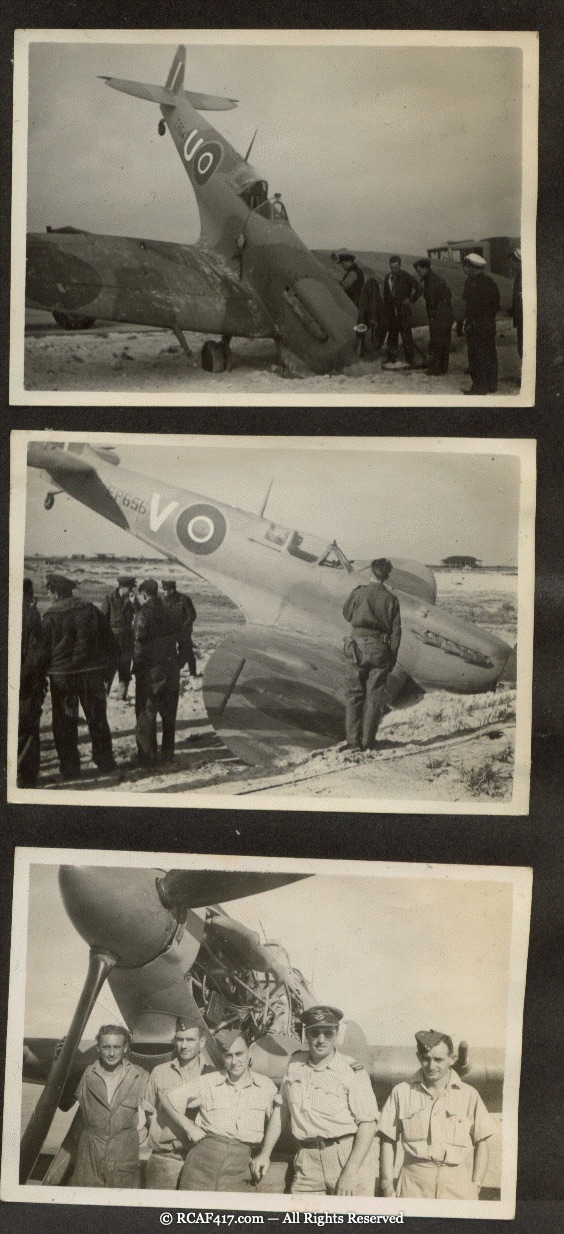
A crash-landed Spitfire, serial EP656, coded "VO," collapsed on its belly with a knot of
airmen and ground crew gathered around it — three photos on this page, the last showing
five men posed in front of the wreck. No names are given. "VO" isn't 417 Squadron's own
"AN" code (see the Squadron History page), so this
aircraft likely belonged to a different unit. Album page courtesy of Guy A. Wood Jr.
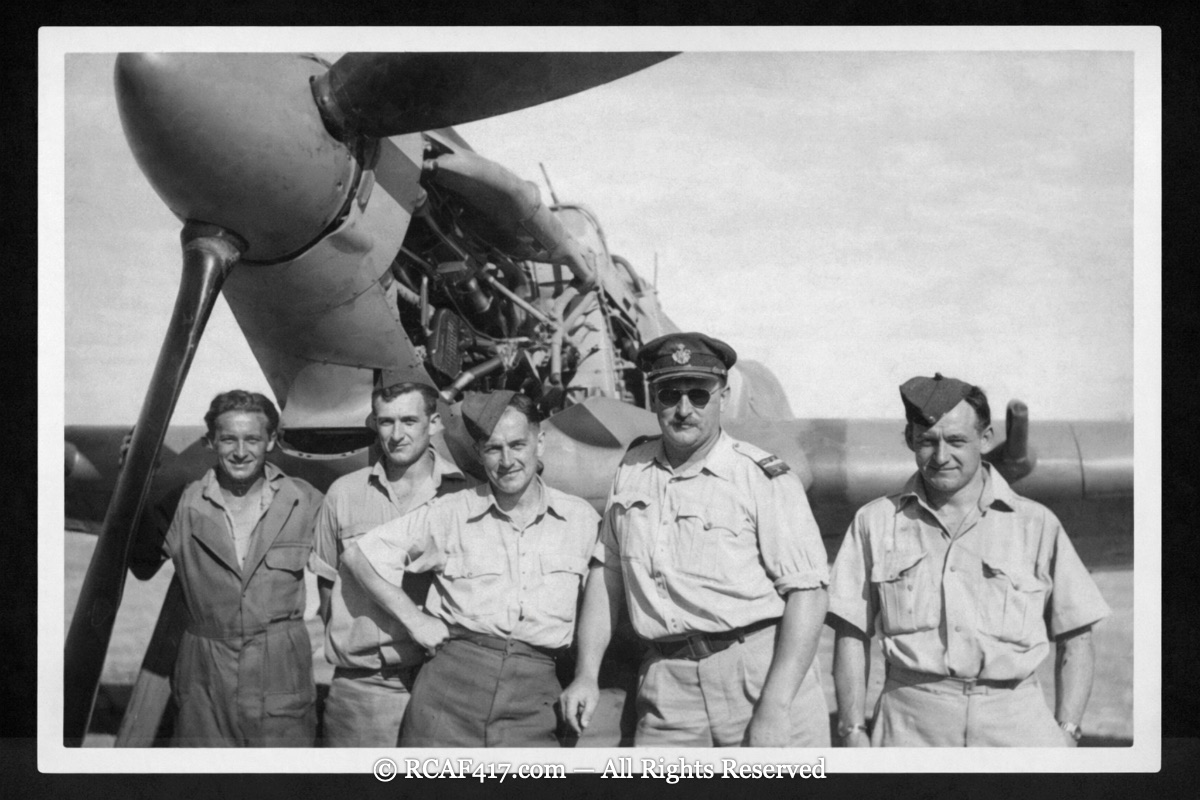
417 Squadron airmen beside a Spitfire's Merlin engine and propeller at a desert airfield.
No names are given on this print, so individual identifications aren't confirmed.
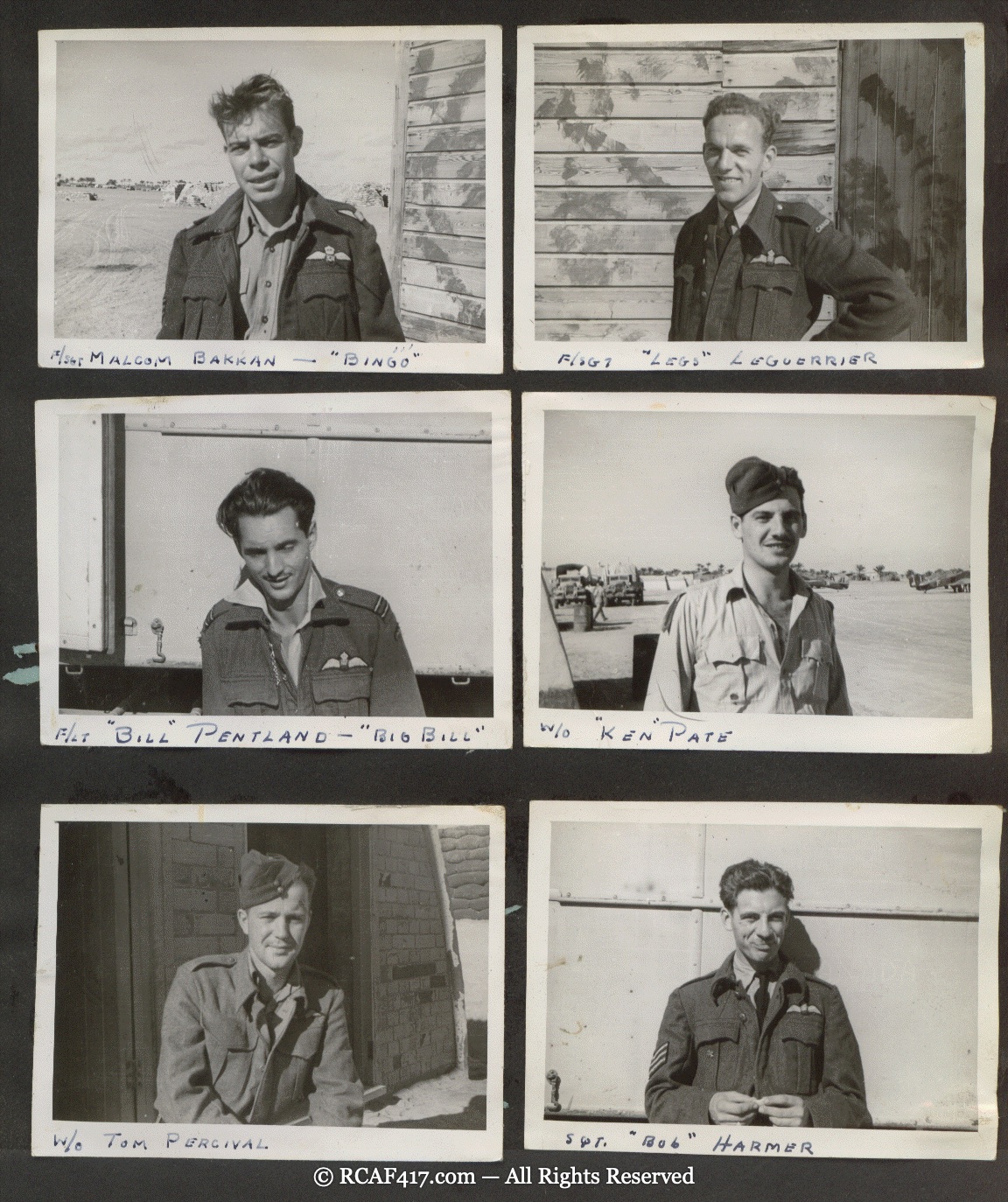
Six more individual portraits, taken in the desert: F/Sgt. Malcolm Bakkan ("Bingo"), F/Sgt.
"Legs" LeGuerrier, F/Lt. "Bill" Pentland ("Big Bill"), W/O "Ken" Pate, W/O Tom Percival, and
Sgt. "Bob" Harmer. Bakkan, LeGuerrier, Pentland, Pate, and Percival are the same men named
only by surname in the Colerne group photograph in
Chapter Two — these portraits put faces and nicknames to
that earlier roster. Album page courtesy of Guy A. Wood Jr.
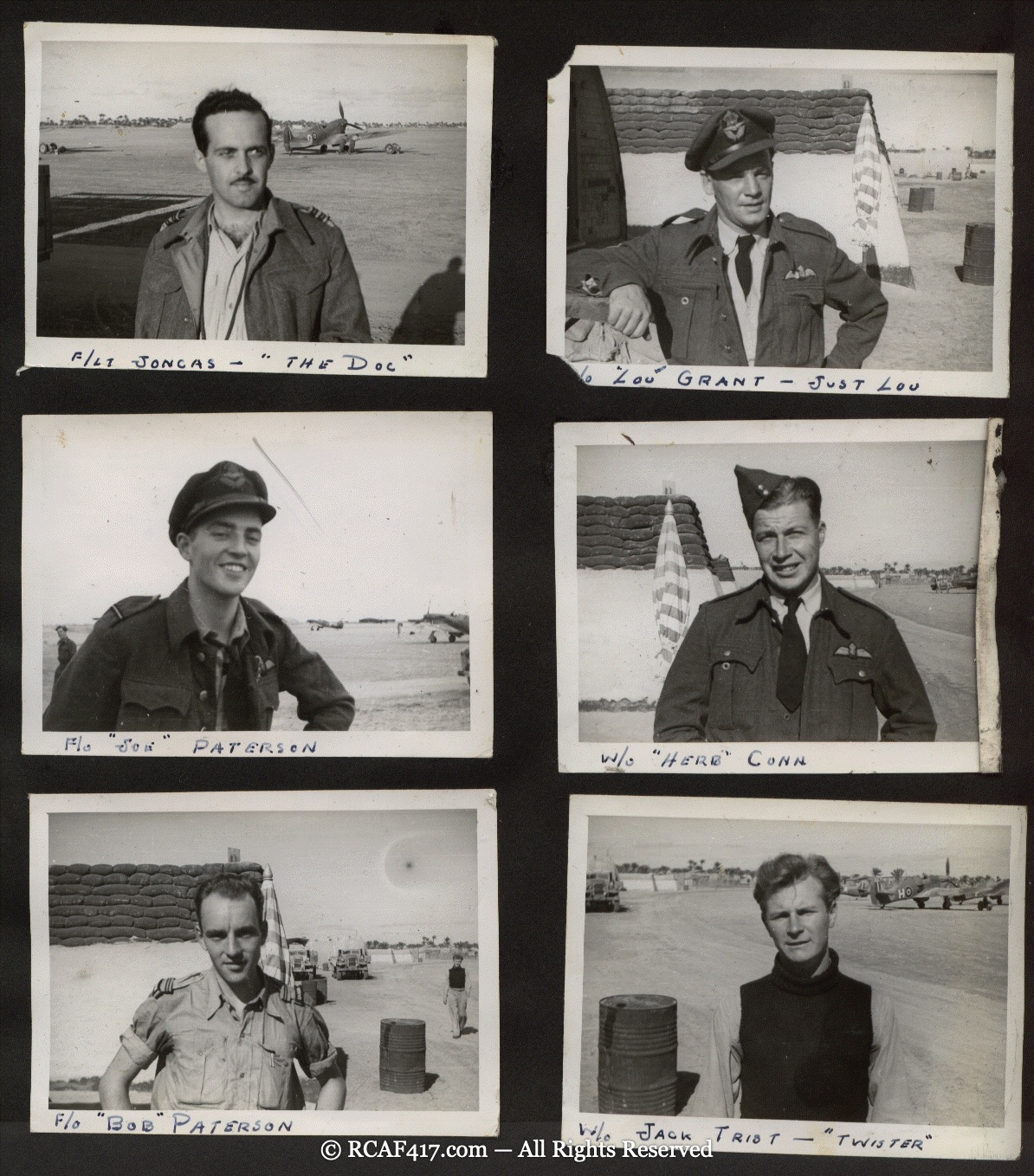
Six more: F/Lt. Joncas ("The Doc"), W/O "Lou" Grant ("Just Lou"), F/O "Joe" Paterson, W/O
"Herb" Conn, F/O "Bob" Paterson, and W/O Jack Triot ("Twister"). Grant and Conn are the same
L. Grant and H. Conn named in the Colerne group photograph in
Chapter Two; one of the two Patersons here may also be
the "J. Patterson" named in that chapter's second group photo, though the spelling differs
slightly and it isn't confirmed. Album page courtesy of Guy A. Wood Jr.
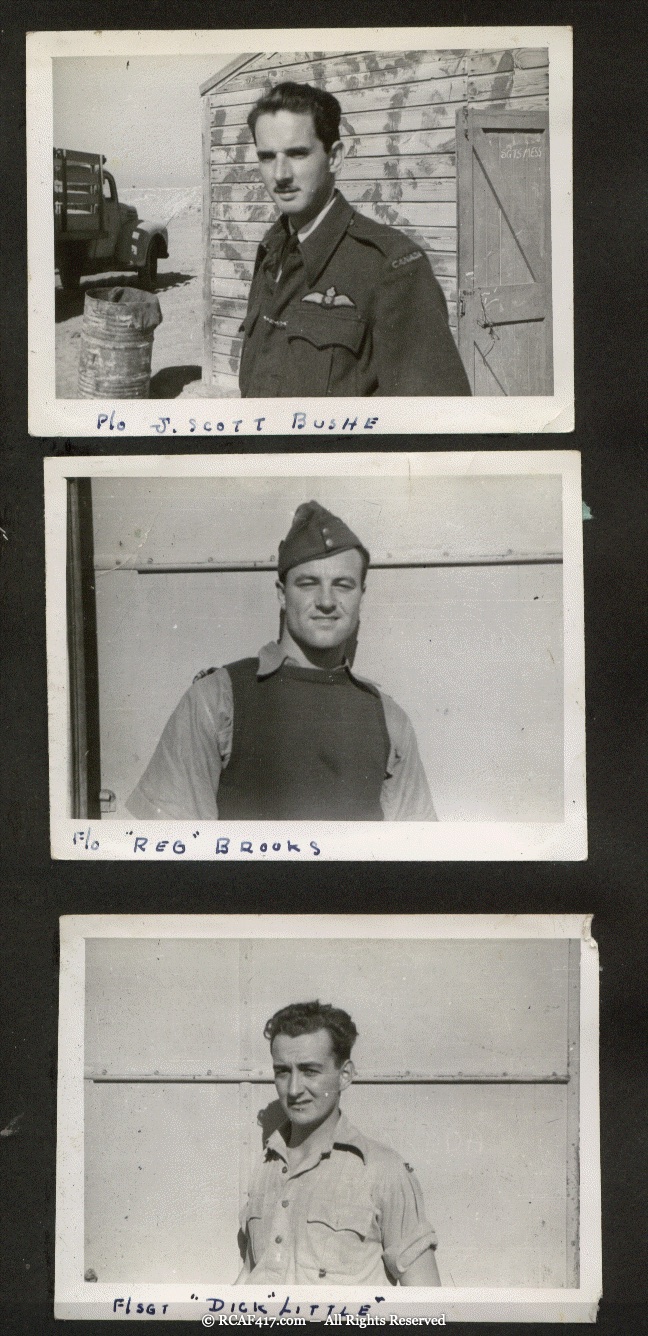
Three more individual portraits: P/O J. Scott Bushe, in front of a wooden hut in the
desert; F/O "Reg" Brooks; and F/Sgt "Dick" Little. Brooks is the same R. Brooks named in
the Colerne group photograph in Chapter Two, and again
in that chapter's second, annotated group photo — this portrait puts a face and nickname to
that roster entry. Album page courtesy of Guy A. Wood Jr.
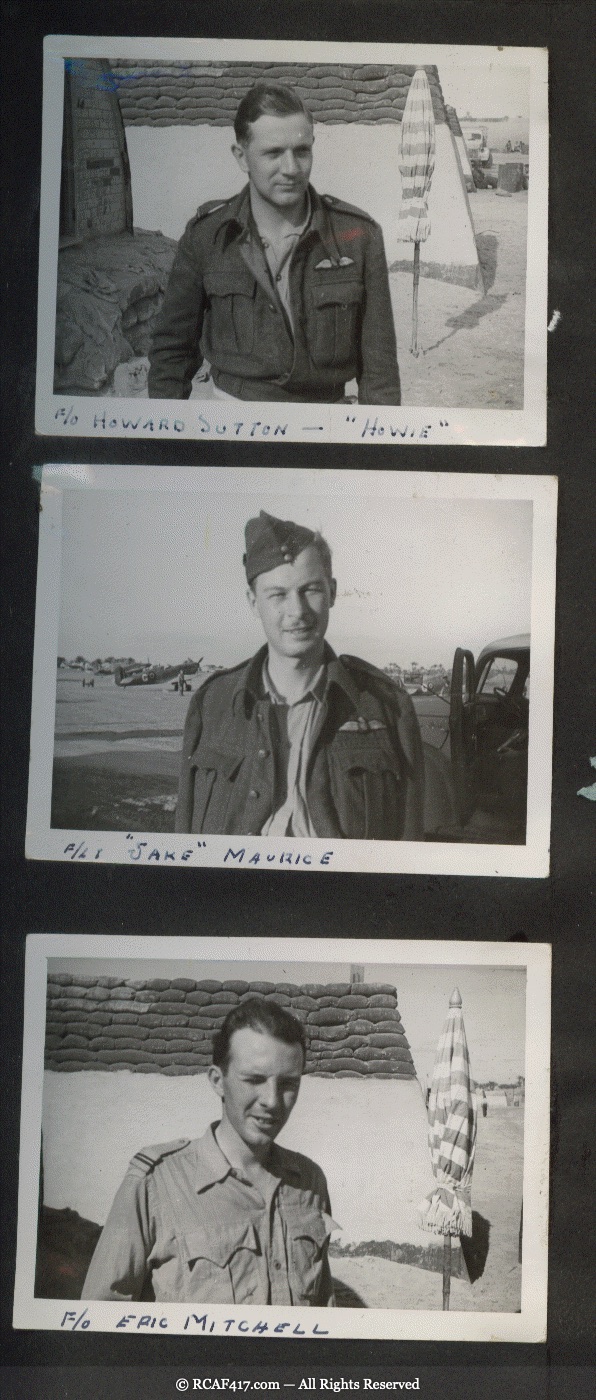
F/O Howard Sutton ("Howie"), F/Lt "Jake" Maurice, and F/O Eric Mitchell. All three are
named by surname only in the Colerne group photograph in
Chapter Two — H. Sutton, J. Maurice, and E. Mitchell —
and Maurice also appears in that chapter's second, annotated group photo. Album page
courtesy of Guy A. Wood Jr.
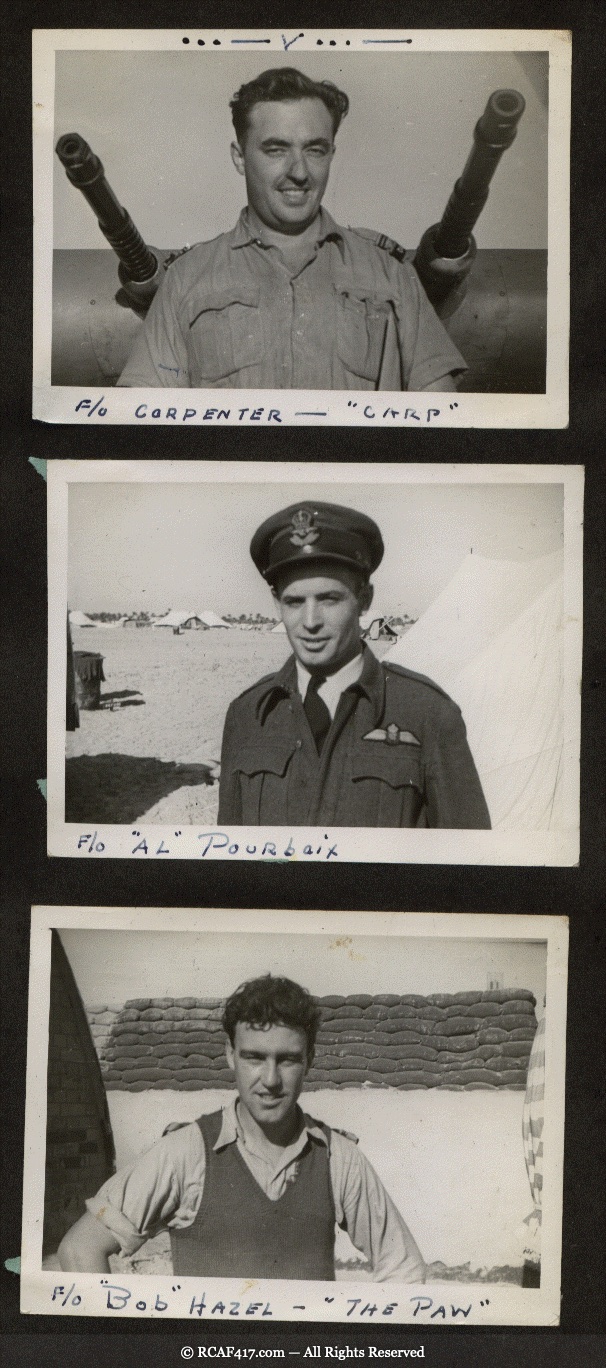
F/O Carpenter ("Carp"), photographed behind a Spitfire's twin machine guns; F/O "Al"
Pourbaix; and F/O "Bob" Hazel ("The Paw"). Pourbaix and Hazel are the same A. Pourbaix and
R. Hazel named in the Colerne group photograph in
Chapter Two; Carpenter doesn't appear on that roster
and may have joined the squadron separately. Album page courtesy of Guy A. Wood Jr.
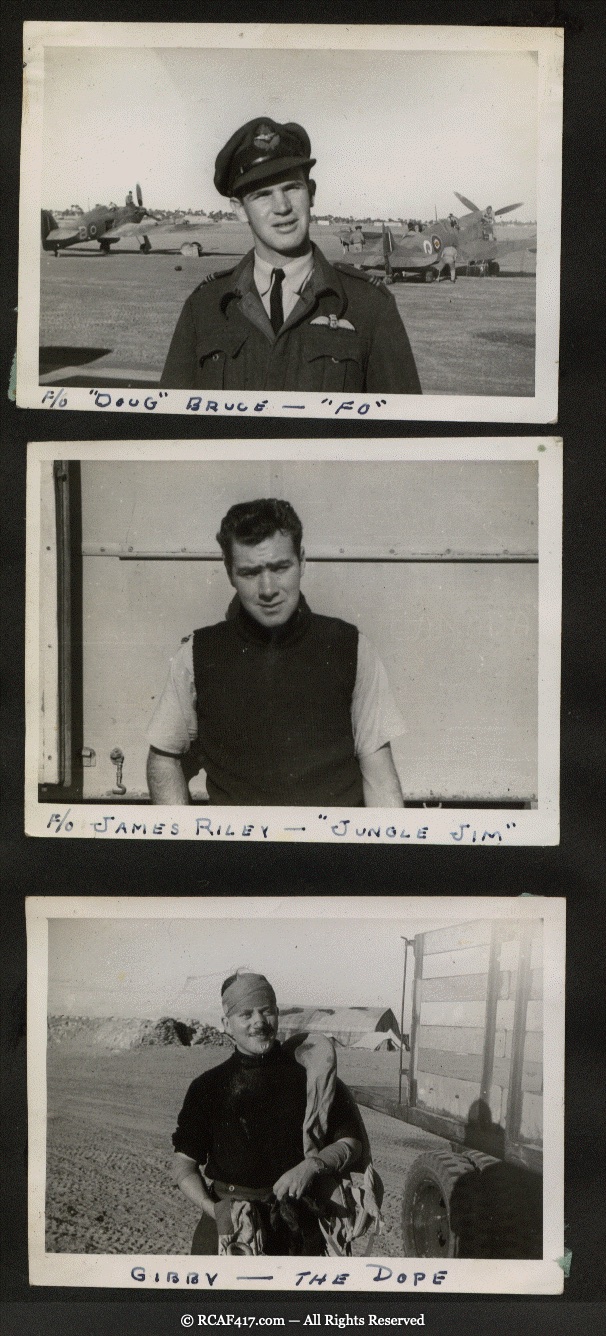
F/O "Doug" Bruce, F/O James Riley ("Jungle Jim"), and "Gibby" ("The Dope"). Bruce is almost
certainly the D. Bruce named in the Colerne group photograph in
Chapter Two, where this identification was already
flagged as likely — this portrait confirms it. Riley's first name here, James, doesn't
quite match John Riley, the wartime friend who mailed home Koplitz's Canada training photo
(see Chapter Two and his February 2001 letter in
Chapter Seven) — quite possibly just an informal-name
variation, the way "Jack" is often used in place of "John," rather than two different men,
though this hasn't been confirmed. "Gibby" is identified
elsewhere in this collection as F/O John "Gibby" Gibson, in the solo portrait below. Album
page courtesy of Guy A. Wood Jr.
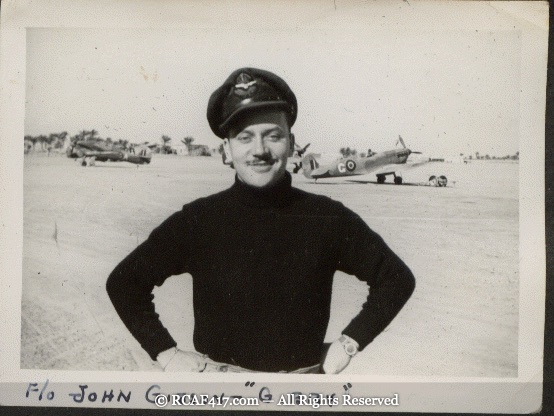
A solo portrait inscribed on the print "F/O John G[...] '[...]'" — the handwriting is hard
to make out — but the source filename identifies him as F/O John "Gibby" Gibson, matching
the "Gibby" nickname on the group portrait page above. Album page courtesy of Guy A. Wood
Jr.
It was here, too, that "Johnnie" the airman and "Johnnie" the bandleader converged. The
official RCAF history The RCAF Overseas: The First Four Years singled him out on
page 335 for leading "the finest five-piece swing band in the desert" — and it was somewhere
in this theater that he found a piano in a bombed Italian church, had it hauled back to the
squadron's airfield, and played it surrounded by Spitfires while off-duty pilots sat on the
wings to listen.
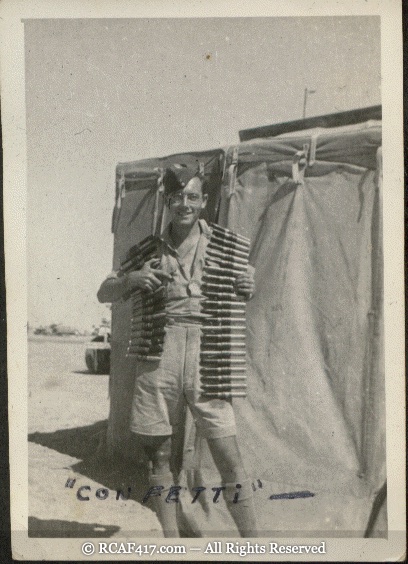
An airman draped in belts of ammunition, mugging for the camera, captioned "Confetti" —
likely a ground armourer showing off a belt of .303 rounds for the Spitfires' guns. No name
is given. Album page courtesy of Guy A. Wood Jr.
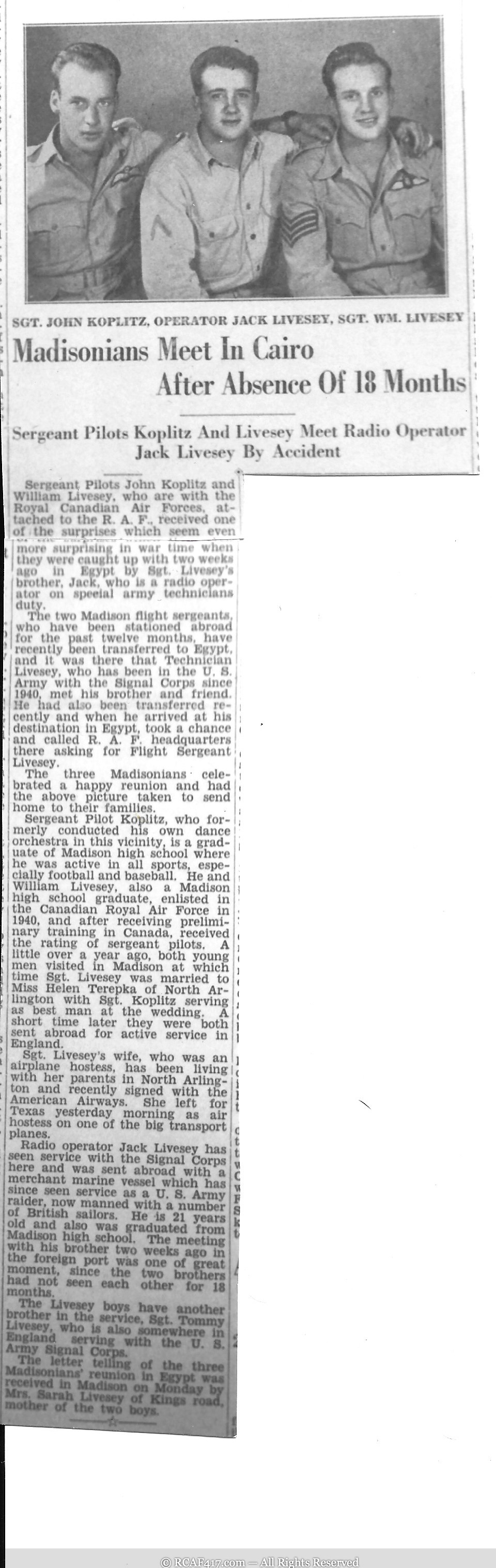
A hometown newspaper clipping: "Madisonians Meet In Cairo After Absence Of 18 Months —
Sergeant Pilots Koplitz And Livesey Meet Radio Operator Jack Livesey By Accident." The
article tells the story in full: Koplitz and fellow RCAF sergeant pilot William Livesey,
both Madison High School graduates who had enlisted and trained together, were serving in
Egypt when Livesey's brother Jack — a U.S. Army Signal Corps radio operator who had arrived
separately, having crossed by merchant ship — took a chance and telephoned RAF headquarters
asking for his brother by name. The three Madisonians hadn't all been together in 18
months; this photograph was taken on the spot to send home to their families. The article
adds a warm detail: about a year before this reunion, William Livesey had married Helen
Terepka of North Arlington back in Madison, with Koplitz serving as his best man. A third
Livesey brother, Tommy, was serving in England with the Army Signal Corps. (Two notes for
the record: this original clipping spells the family name "Livesey" throughout, worth
checking against the framed article Joe has, since it's appeared elsewhere as "Livsey"; and
the article states both men enlisted in 1940, which doesn't quite match the January 30,
1941 date on Koplitz's own signed enlistment agreement in
Chapter Two — the primary document takes precedence,
but it's noted here rather than silently ignored.)
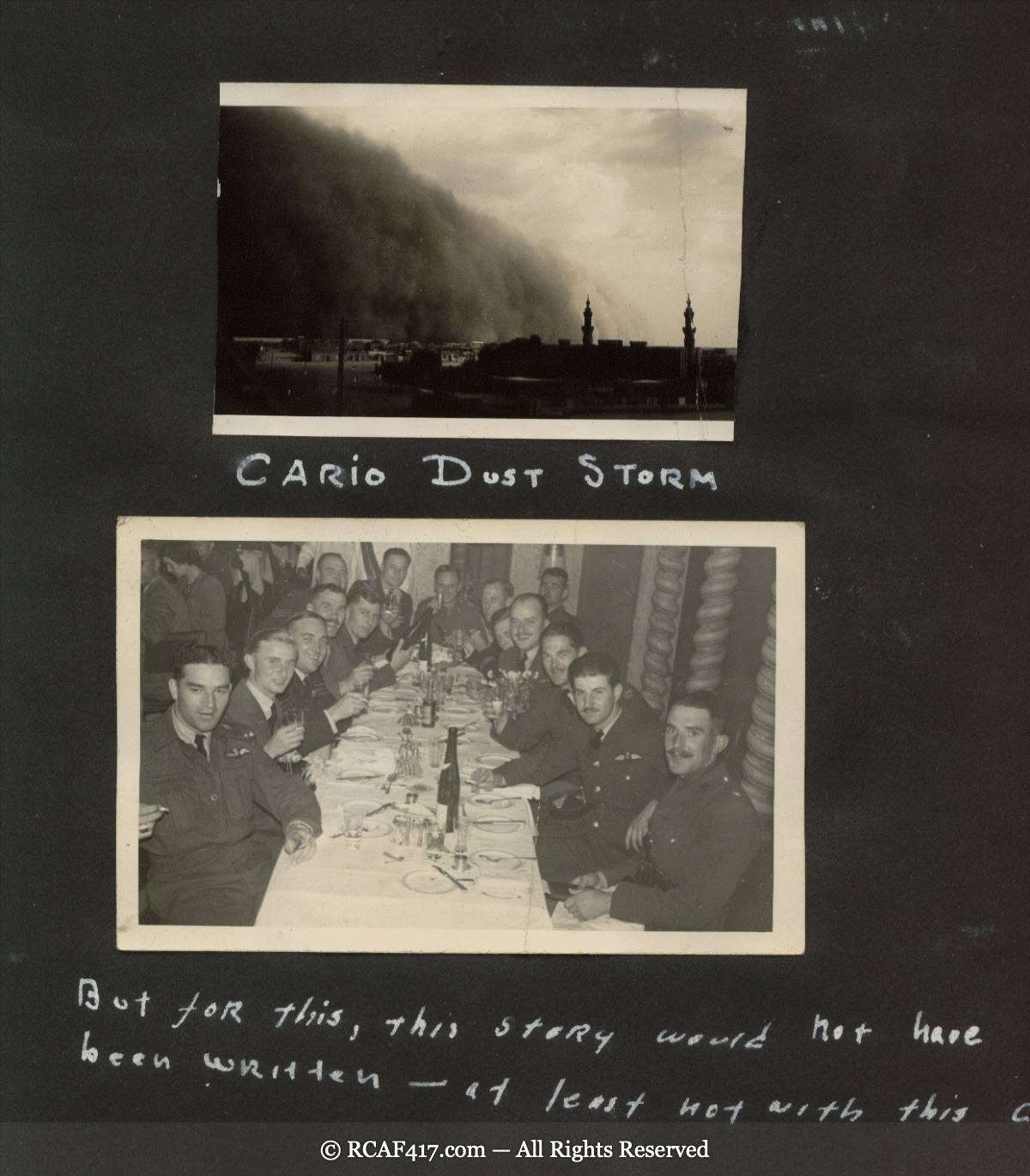
A sandstorm rolling toward Cairo, its minarets silhouetted against the approaching wall of
dust, captioned "Cario [sic] Dust Storm"; and below it, a formal officers' dinner around a
long banquet table, glasses raised. A handwritten note beneath is cut off at the edge of
the page, reading in part: "But for this, this story would not have been written — at
least not with this c[...]" — the rest of the note, and whatever story it refers to, hasn't
survived on this scan. Album page courtesy of Guy A. Wood Jr.
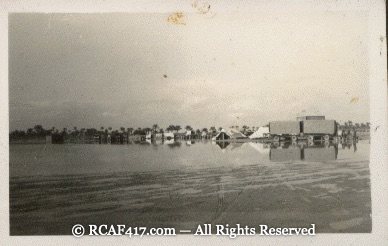
An unlabeled photograph of a flooded settlement — low buildings and palm trees reflected in
standing water, possibly after a Nile flood or heavy seasonal rain. No caption or location
is given on the print. Album page courtesy of Guy A. Wood Jr.
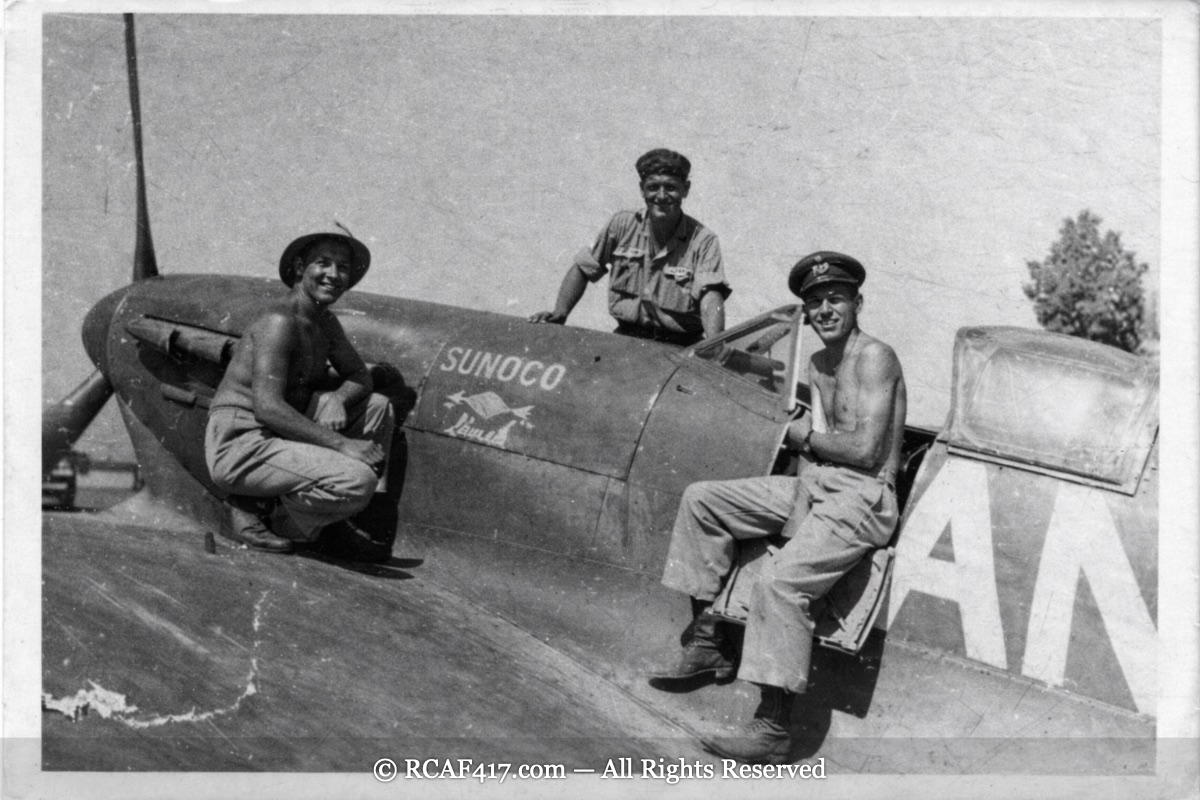
A lighter moment in the desert: two shirtless airmen and a ground crewman relax on a
Spitfire in Egypt, its nose marked "SUNOCO" with a winged emblem — squadron aircraft were
often given informal nose art and nicknames of their own. The squadron code letters "AN"
are visible on the fuselage. Names aren't given on this print.
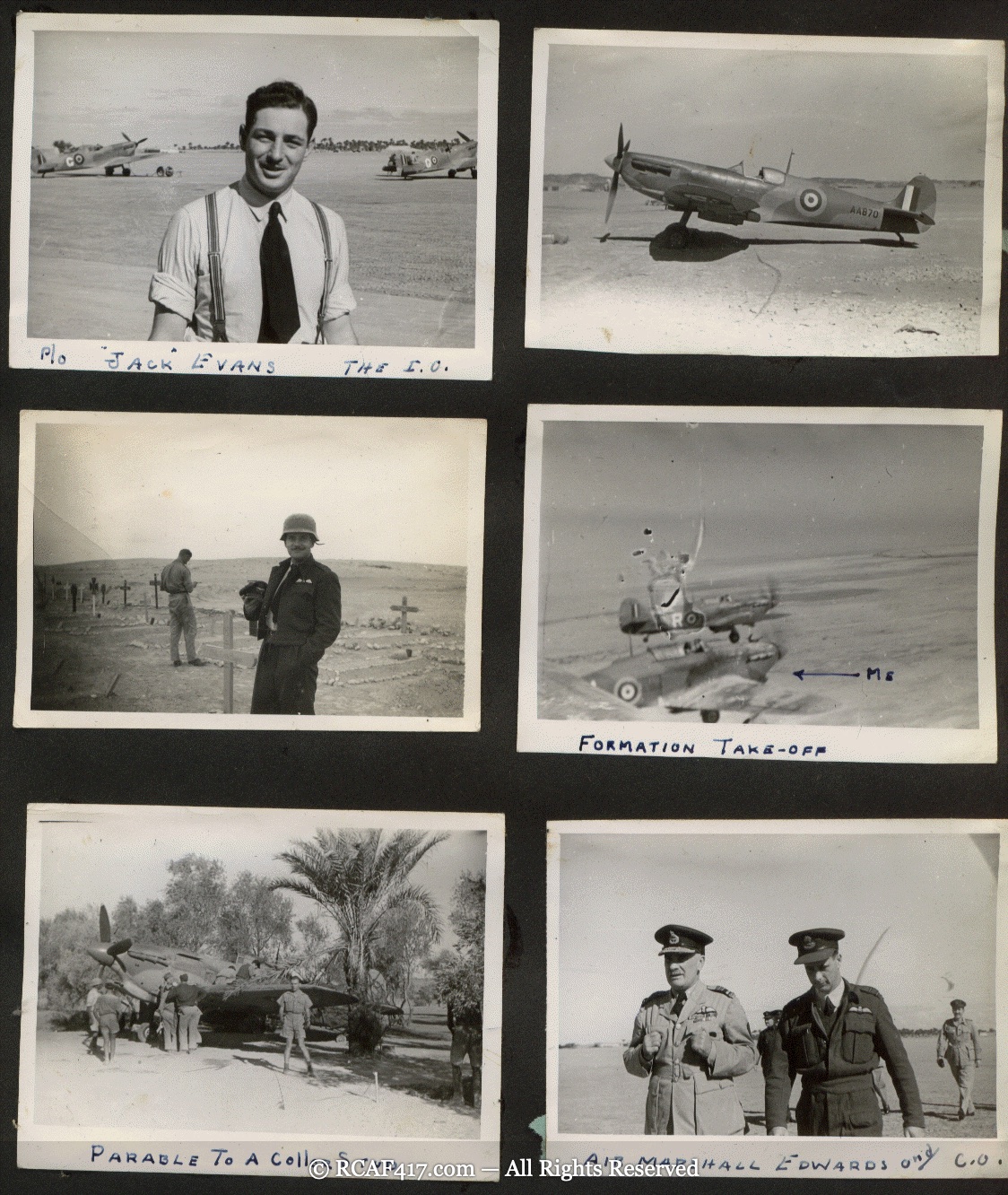
P/O "Jack" Evans, captioned on the print as "The I.O." — the squadron's Intelligence
Officer; an unidentified airman beside a German military cemetery, apparently holding a
captured German helmet; "Formation Take-off," two aircraft lifting off together; a badly
damaged Spitfire under a palm tree with ground crew working around it, partly captioned
"Parable to a Coll[apsed?] S[tud?]"; and a senior-officer visit captioned "Air Marshal
Edwards and C.O." Note: this print's "The I.O." caption for Jack Evans
differs from the "Commanding Officer" description of Jack Evans currently in
Chapter Seven — worth confirming which is correct before
that text is changed. Separately, this "Air Marshal Edwards" is almost certainly a distinct,
far more senior officer from J.F. Edwards, the 15-kill flying ace named on the
417 Squadron History page — no relation between the
two should be assumed. Album page courtesy of Guy A. Wood Jr.
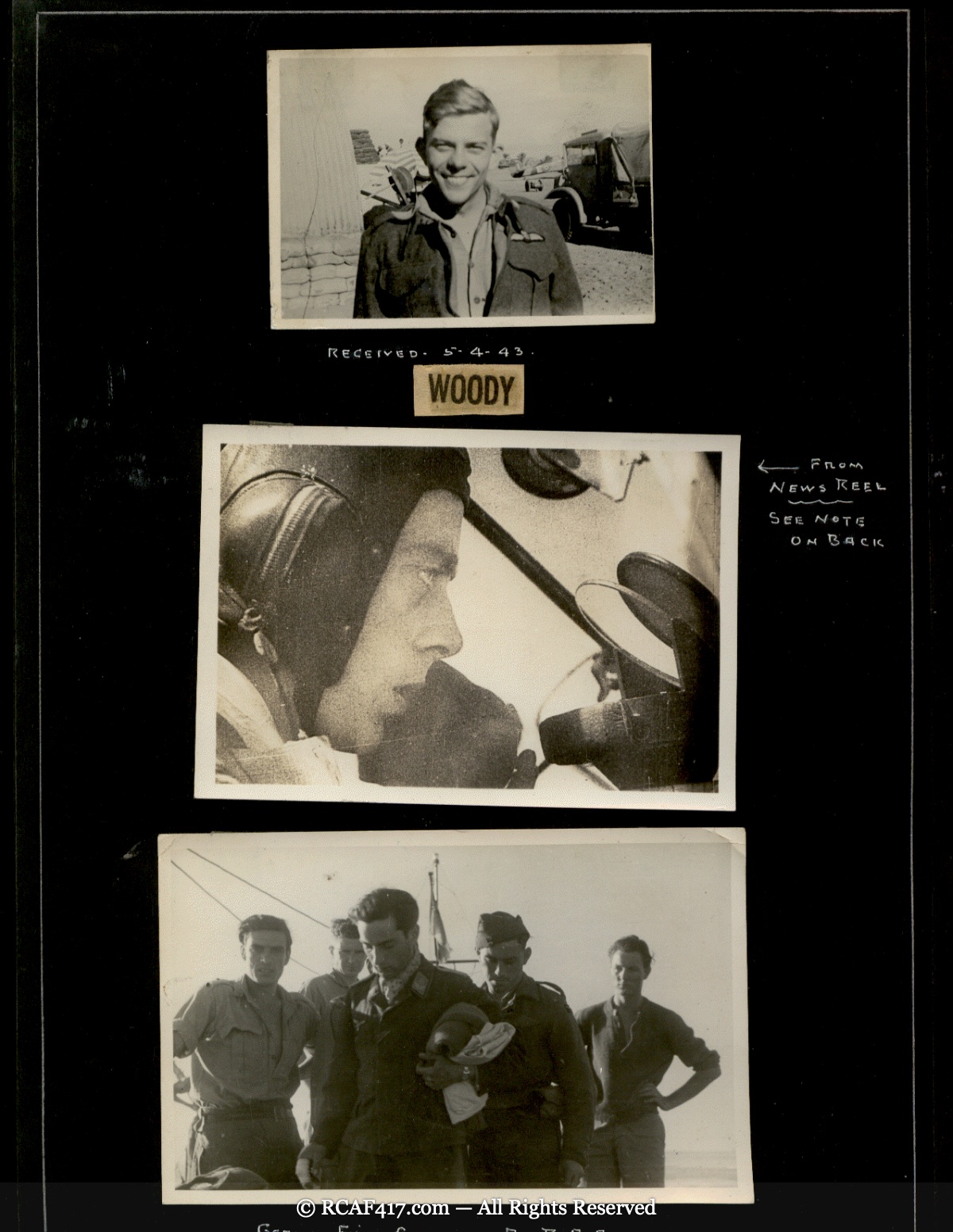
A page labeled "Woody" and "Received. 5-4-43": a smiling young airman in service dress,
photographed beside a tent and truck; a newsreel-still profile of a pilot in a cockpit,
marked "From News Reel — See Note on Back"; and a group snapshot of five men, one of them
holding a cap and wearing a tunic that doesn't match the others' service dress — possibly a
captured item worn for the photo, though this isn't confirmed. Given the donor's name,
"Woody" may well be Guy A. Wood himself, the original compiler of this album, rather than
another member of 417 Squadron — this page likely documents him rather than Koplitz. Album
page courtesy of Guy A. Wood Jr.
On July 24, 1942, Koplitz's actions earned him the Distinguished Flying Cross — one of only
nine pilots in the entire history of 417 Squadron to receive it. The award was formally
published in the Canada Gazette, Vol. 77, No. 20, May 15, 1943.
RCAF Service Award Card confirming medals (to be added from family archive)
RCAF Service Award Card confirming Koplitz's decorations.
On June 7, 1943, with an official RAF clearance letter in hand, Koplitz transferred out of
the RCAF to the United States Army Air Forces, giving a forwarding address of c/o USAAF
Headquarters, Cairo. His desert war was over; his war over Europe was about to begin.
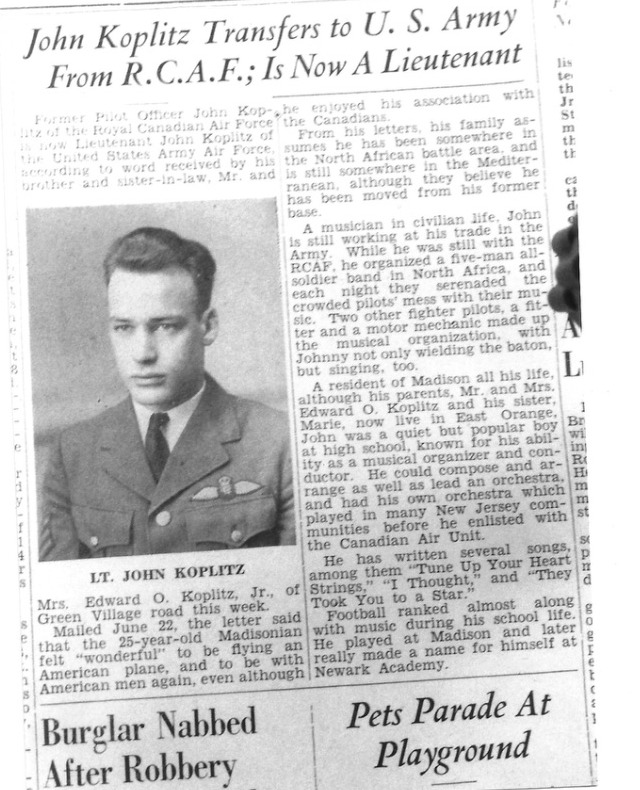
A hometown clipping headlined "John Koplitz Transfers to U.S. Army From R.C.A.F.; Is Now A
Lieutenant," reporting news relayed in a letter mailed June 22 — matching the transfer
described above almost exactly. The article fills in real texture: the 25-year-old felt
"wonderful" to be flying an American plane and back among American men, even though he'd
enjoyed his time with the Canadians; his family believed from his letters that he'd been
moved from his old base but was still somewhere in the Mediterranean. It also expands on
his musical side — while still with the RCAF he organized a five-man all-soldier band in
North Africa (two fighter pilots, a fitter, and a motor mechanic, with Koplitz conducting
and singing) that serenaded the crowded pilots' mess each night, a detail that fits
alongside the piano story above — and adds one not captured elsewhere in this archive: he
"really made a name for himself" playing football at Newark Academy. Three of his own
compositions are named: "Tune Up Your Heart Strings," "I Thought," and "They Took You to a
Star." A second clipping of the same story, evidently from a different paper, exists in the
collection but is too degraded to transcribe reliably.