Nearly a year before the United States entered the Second World War, John Francis Koplitz
crossed into Canada and enlisted in the Royal Canadian Air Force. He signed his JATP Canada
enlistment agreement on January 30, 1941, in Ottawa — a volunteer's choice, made while his own
country was still officially at peace.
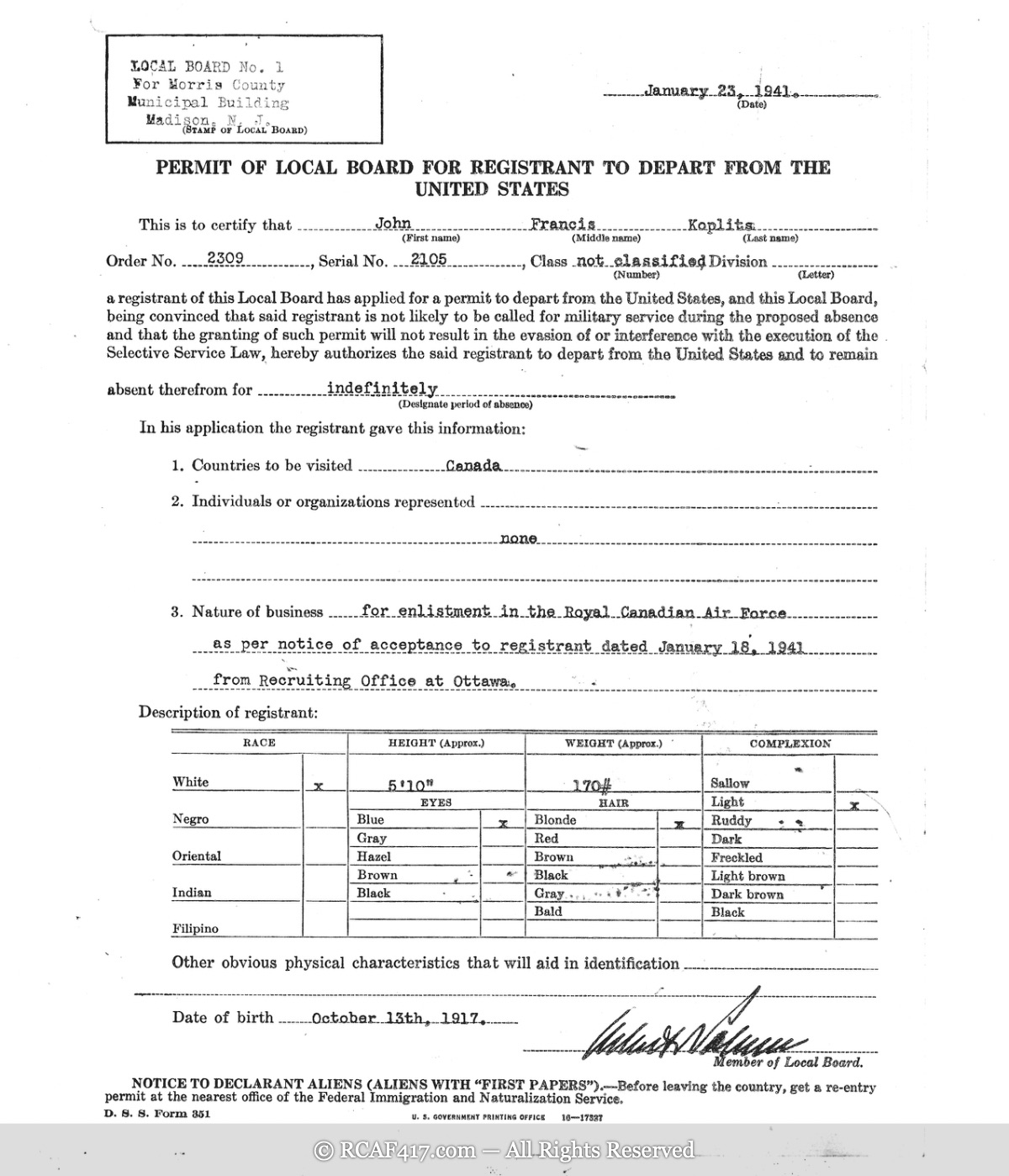
A week before he signed his RCAF enlistment agreement, Koplitz still had to clear his own
country's draft board. This is his U.S. Selective Service "Permit of Local Board for
Registrant to Depart from the United States," issued January 23, 1941, by Local Board No.
1 for Morris County, at the Municipal Building in Madison, N.J. It authorizes him to leave
the country and remain absent "indefinitely," with the stated purpose "for enlistment in
the Royal Canadian Air Force, as per notice of acceptance to registrant dated January 18,
1941, from Recruiting Office at Ottawa." The physical description on file: white, 5'10",
170 lbs., light complexion, blue eyes, blonde hair — and his date of birth, October 13,
1917, matching the rest of his record. The document firmly places his enlistment process in
January 1941, corroborating the date on the agreement below over the looser "1940" given in
the "Madisonians Meet In Cairo" newspaper clipping in
Chapter Three.
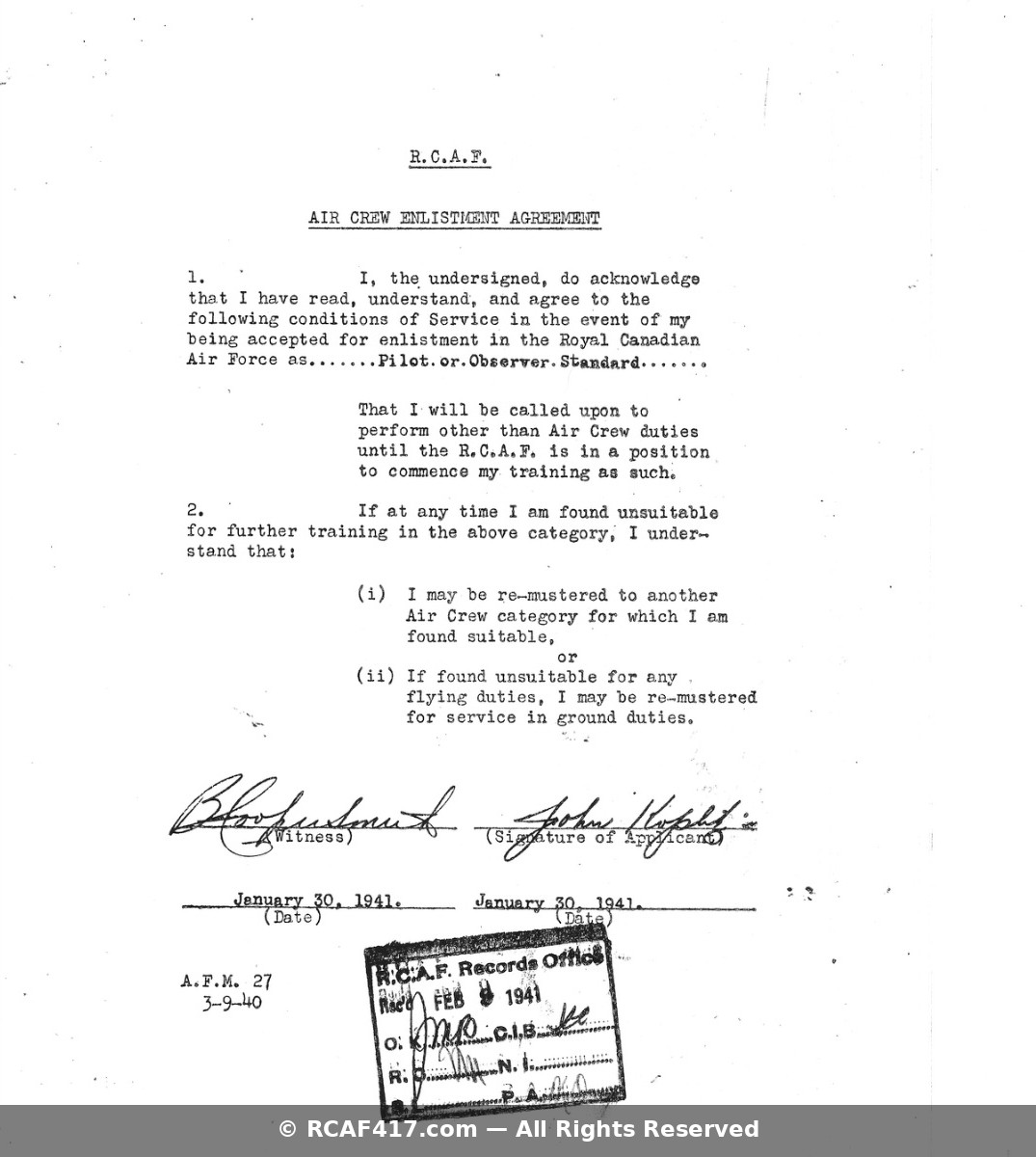
Koplitz's RCAF Air Crew Enlistment Agreement, signed January 30, 1941, and
stamped received by the R.C.A.F. Records Office on February 8, 1941.
He was given RCAF service number R82756 as a non-commissioned airman — a number that would
later change to J16766 on his commissioning as an officer. Training took him across the
country: postings in Quebec, Edmonton, and Prince Edward Island carried him through the
stages of RCAF flight training, from raw recruit toward operational pilot.
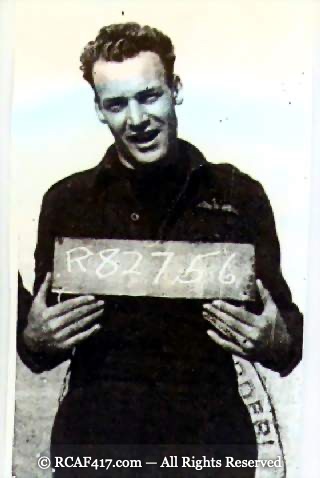
Koplitz holding a slate board with his newly assigned RCAF service number, R82756 — very
likely taken during his induction into the Air Force, before he'd even been issued a
uniform.
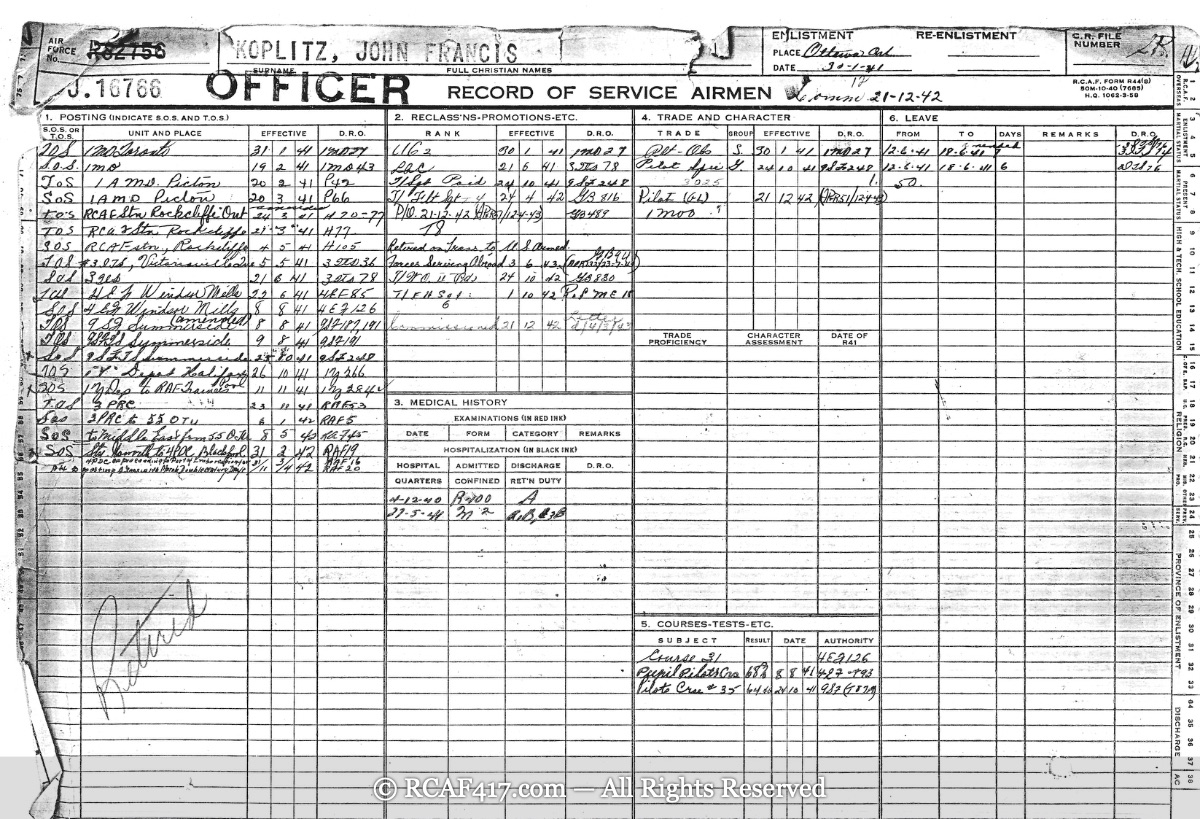
A page from Koplitz's official RCAF Record of Service ledger, the master record the Air
Force kept of every airman's postings, rank changes, and trade classifications. The header
confirms his enlistment at Ottawa, Ontario, on January 30, 1941 — matching the enlistment
agreement above — and the rows below trace his actual route from there: training postings
across Canada (Toronto, Picton, Rockcliffe, Victoriaville, Windsor Mills, and finally
Summerside, Prince Edward Island), then overseas to England — a Personnel Reception Centre
and an Operational Training Unit, where pilots converted onto their combat aircraft — and
from there, a line reading "to Middle East," the posting that took him into the desert war
told in Chapter Three. Much of the handwritten shorthand
is dense period abbreviation and not every entry is transcribed with full confidence here,
but this single page is the primary-source record of his entire journey from enlistment to
the front — a document a historian or researcher would find genuinely useful.
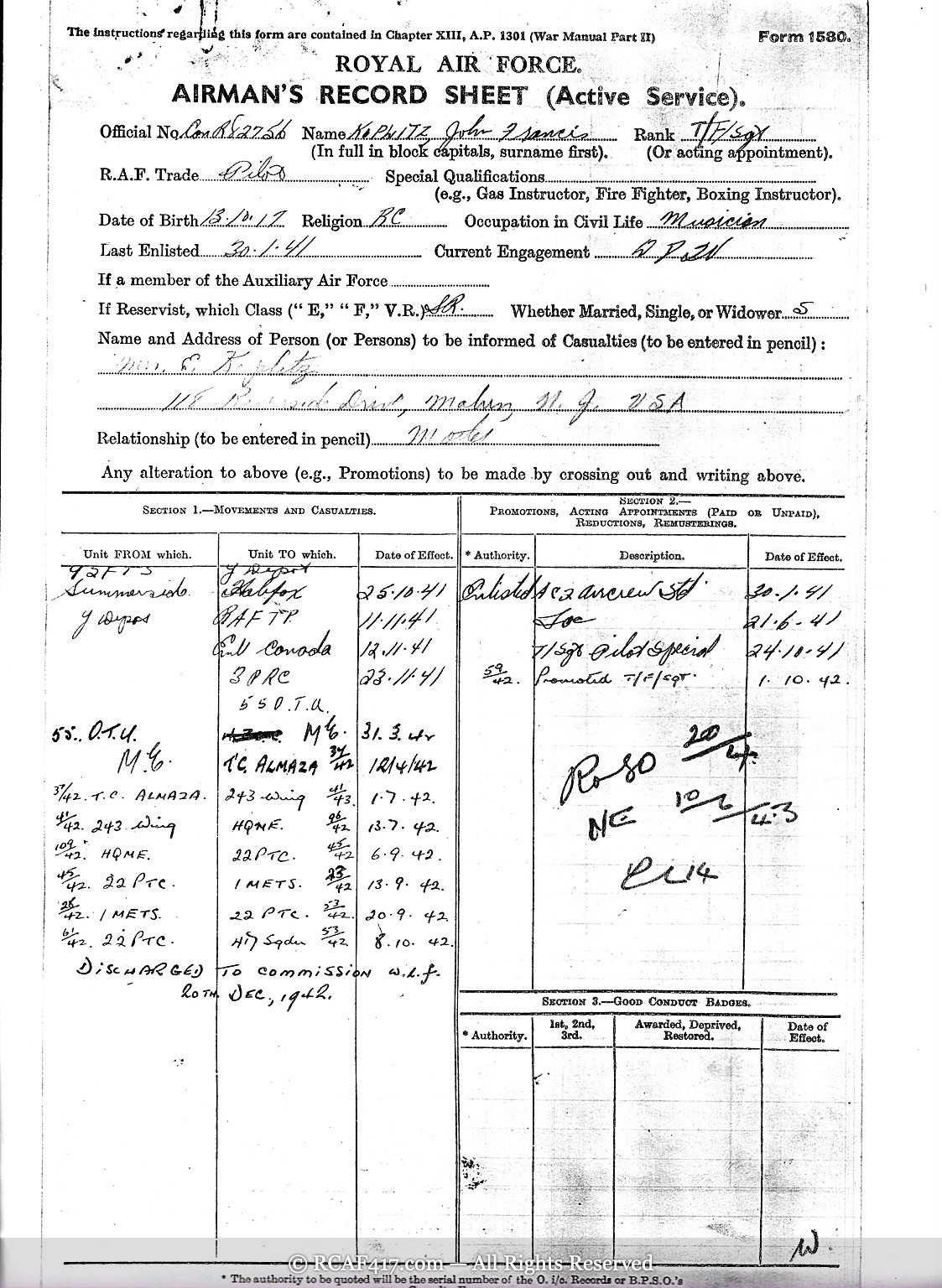
A companion document to the ledger page above: Koplitz's Royal Air Force "Airman's Record
Sheet (Active Service)," Form 1580 — service number R82756, trade Pilot, occupation in
civil life given simply as "Musician." It confirms his enlistment date (30.1.41) and traces
his movements in finer detail: from Summerside, P.E.I., to a "Y" Depot at Halifax in
October 1941, overseas to England that November, then on through the Middle East pipeline
— a Personnel Reception Centre, an Operational Training Unit, and Transit Camp Almaza,
Cairo — before two further postings put him at 417 Squadron on 8.10.42 (October 8,
1942), matching the date already established in
Chapter Three. The promotions column independently
confirms his advance to Temporary Flight Sergeant effective 1.10.42 (October 1,
1942) — again matching Chapter Three exactly. Most usefully, the movements column
ends with "Discharged to commission, w.e.f. 20th Dec. 1942" — "with effect from" — which
resolves a discrepancy raised earlier in this project: Chapter Three's stated commissioning
date of December 20/21, 1942, is the official paperwork date, while a March 12, 1943 V-mail
letter from Koplitz saying he'd "received my commission yesterday" is simply when the news
and the physical paperwork caught up with him in the field, months later — not a
contradiction, just wartime mail catching up to wartime bureaucracy. The named next of kin
is his mother, listed at the family's Madison, N.J. address.
A further batch of official record pages from the same family file adds detail rather than
changing the story told above — several are companion documents to the ledgers already shown,
recording the same facts on different forms, while a few surface entirely new information.
They're presented here together for anyone tracing the paper trail in full.
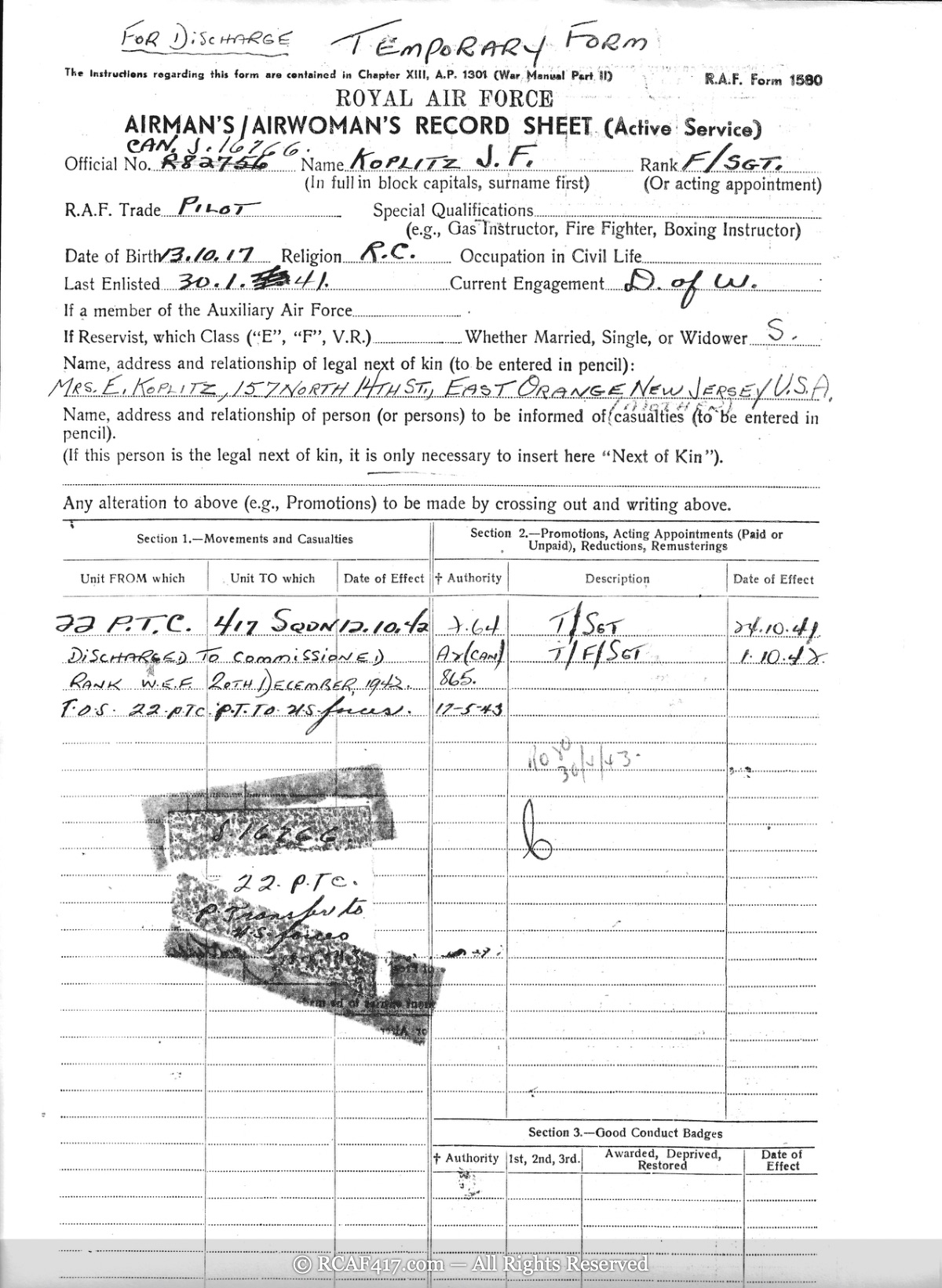
A second copy of the Airman's Record Sheet above, this one headed "Temporary Form" and
"For Discharge." It gives a different next-of-kin address — 157 North 14th St., East
Orange, N.J., rather than the family's longtime Madison address — and closes with the same
milestones told slightly differently: transfer from 22 P.T.C. to 417 Squadron dated
12.10.42 here (a few days later than the 8.10.42 given on the copy above and in Chapter
Three — the handwriting on both is dense and it isn't clear which date is the more precise
one), discharge to commission "w.e.f. 20th December 1942" matching exactly, and a transfer
to U.S. forces dated 17.5.43 — about six weeks later than the 3.6.43 transfer date given on
the Officer's record cards below. Both dates may simply mark different administrative steps
in the same transfer rather than a real conflict.
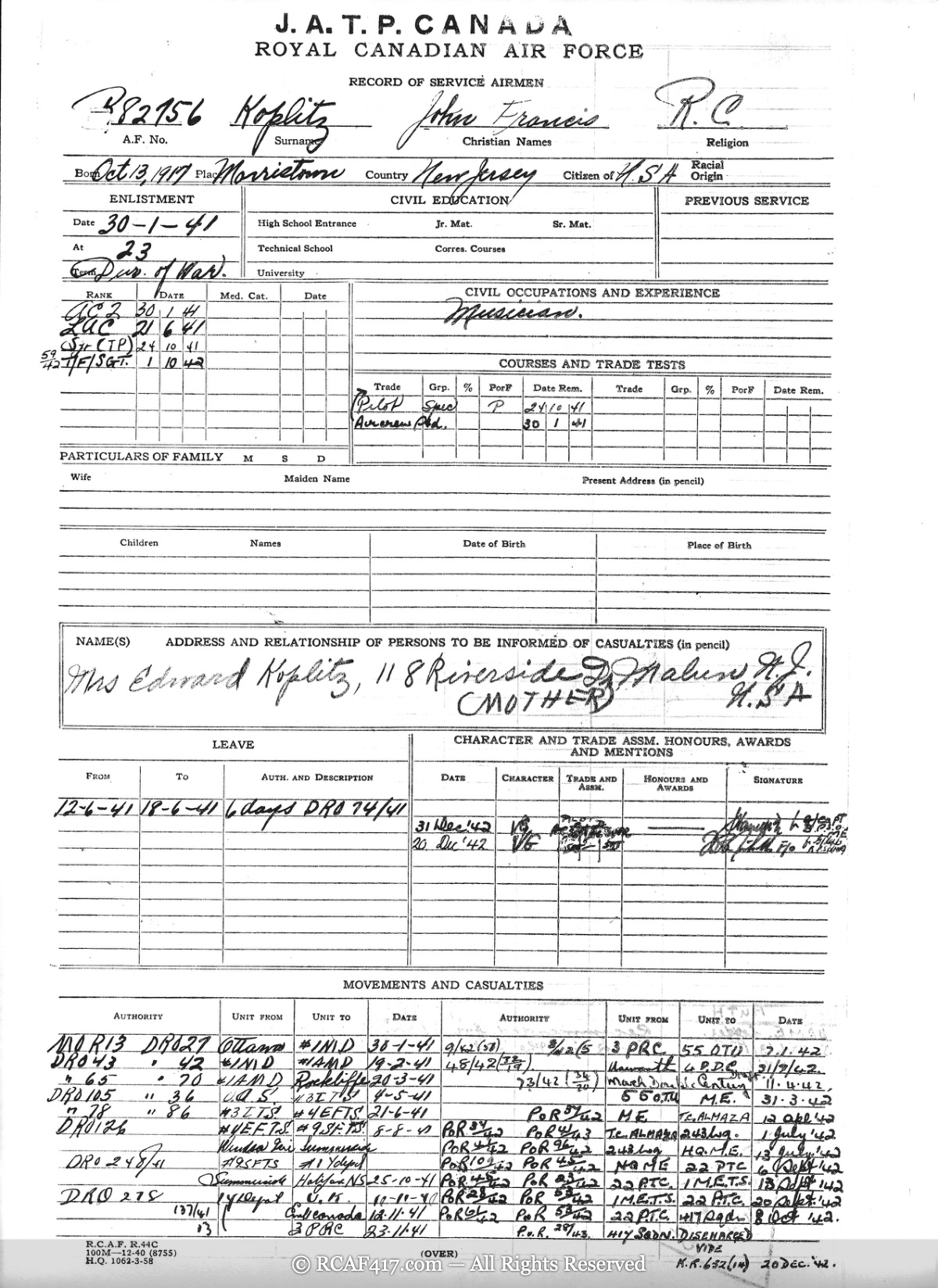
A clearer, more fully legible companion to the RCAF Record of Service ledger page earlier
in this chapter — headed "J.A.T.P. Canada" and tracing the same postings in a different
table format, from enlistment at Ottawa on January 30, 1941, through the training postings
across Canada, overseas, and finally "417 Sqdn. Discharged" on the December 1942
commissioning date. Where the earlier page left some entries only partly legible, this copy
confirms most of them.
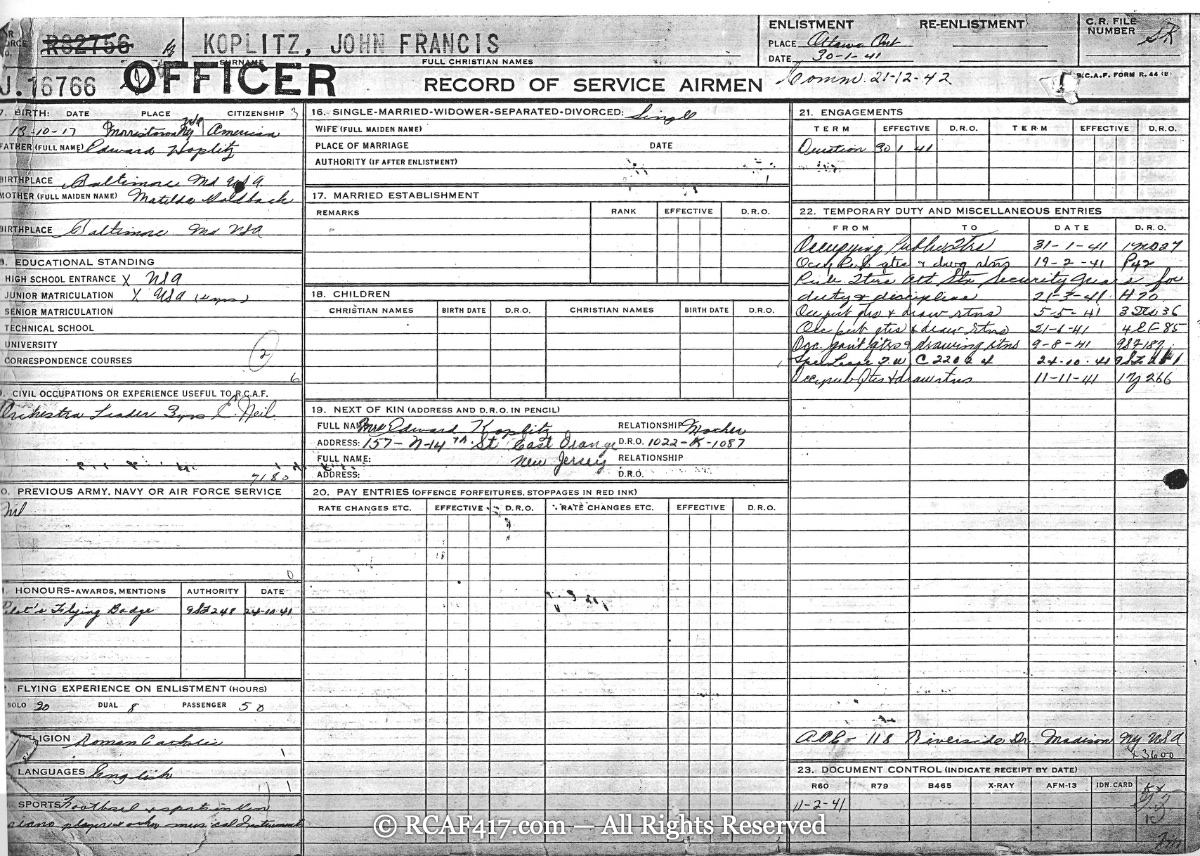
Koplitz's RCAF "Record of Service — Officer" card, a form not seen elsewhere in this
archive. It fills in family and personal detail the postings ledgers don't carry: his
parents, Edward Koplitz and Matilda Goldbach, both born in Baltimore, Maryland; his
education (high school entrance and four years of junior matriculation in New Jersey, plus
two correspondence courses); his civil occupation, given simply as "Orchestra Leader, 3
yrs"; his flying experience on enlistment (20 hours solo, 8 dual, 50 as passenger); and his
Pilot's Flying Badge, awarded October 24, 1941. Next of kin is again given at the East
Orange address, with the family's more familiar Madison, N.J. address added afterward as a
forwarding note. On the Goldbach side, Koplitz's maternal grandfather was Leo Goldbach, an
optometrist in Baltimore.
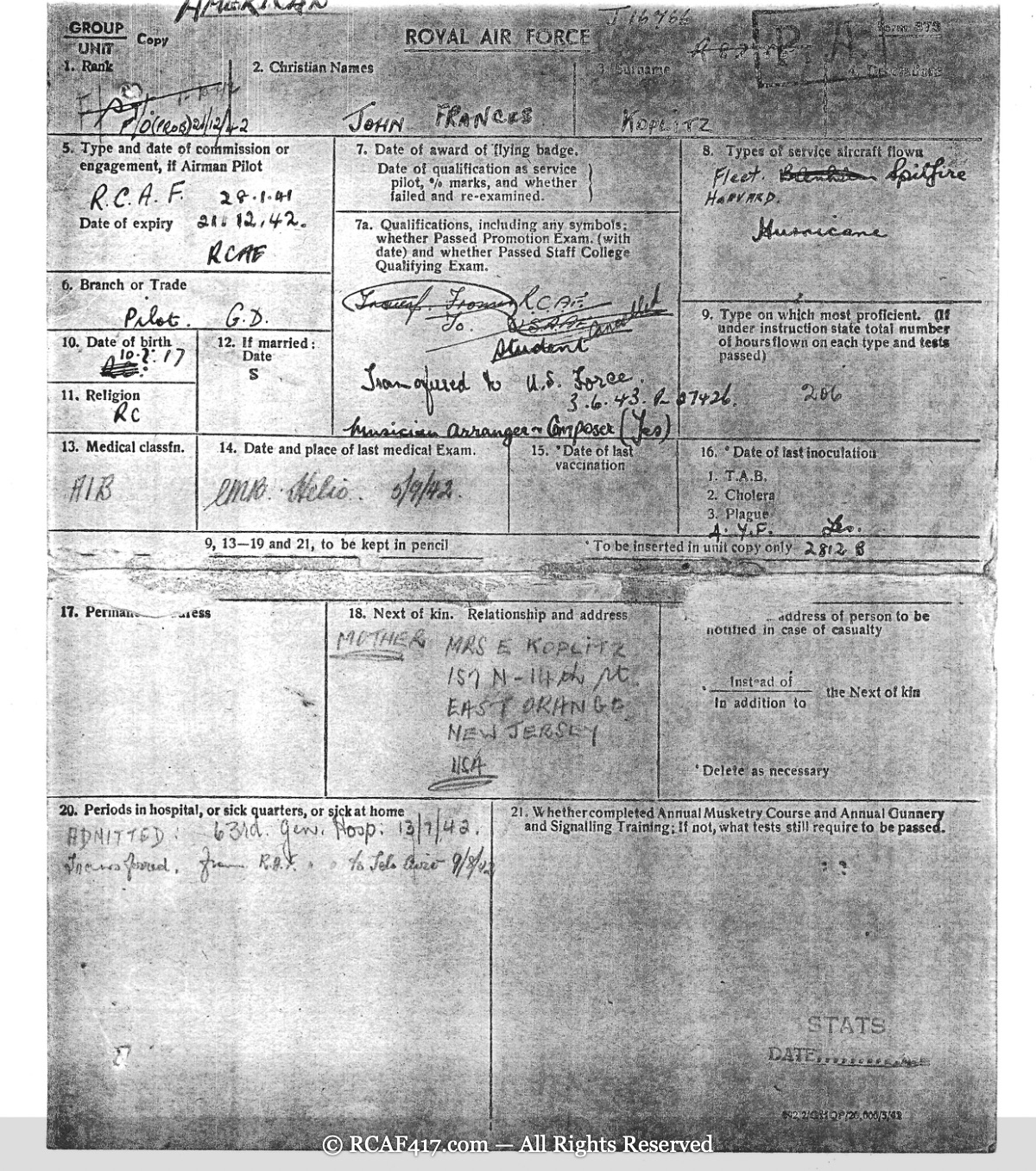
A Royal Air Force "Officer" personal record card (Form 373), filled in later in his service
and marked "American" at the top. This one is the richest single new document in this
batch: it lists the types of service aircraft he flew — Fleet, Blenheim, Spitfire, Harvard,
and Hurricane — records a hospital admission at the 63rd General Hospital on July 13, 1942,
and confirms his transfer to the U.S. Army Air Forces on June 3, 1943, with his new American
serial number, R07426, and 266 total flying hours. A line under qualifications even lists
his civilian skill on file: "Musician, Arranger-Composer — Yes."
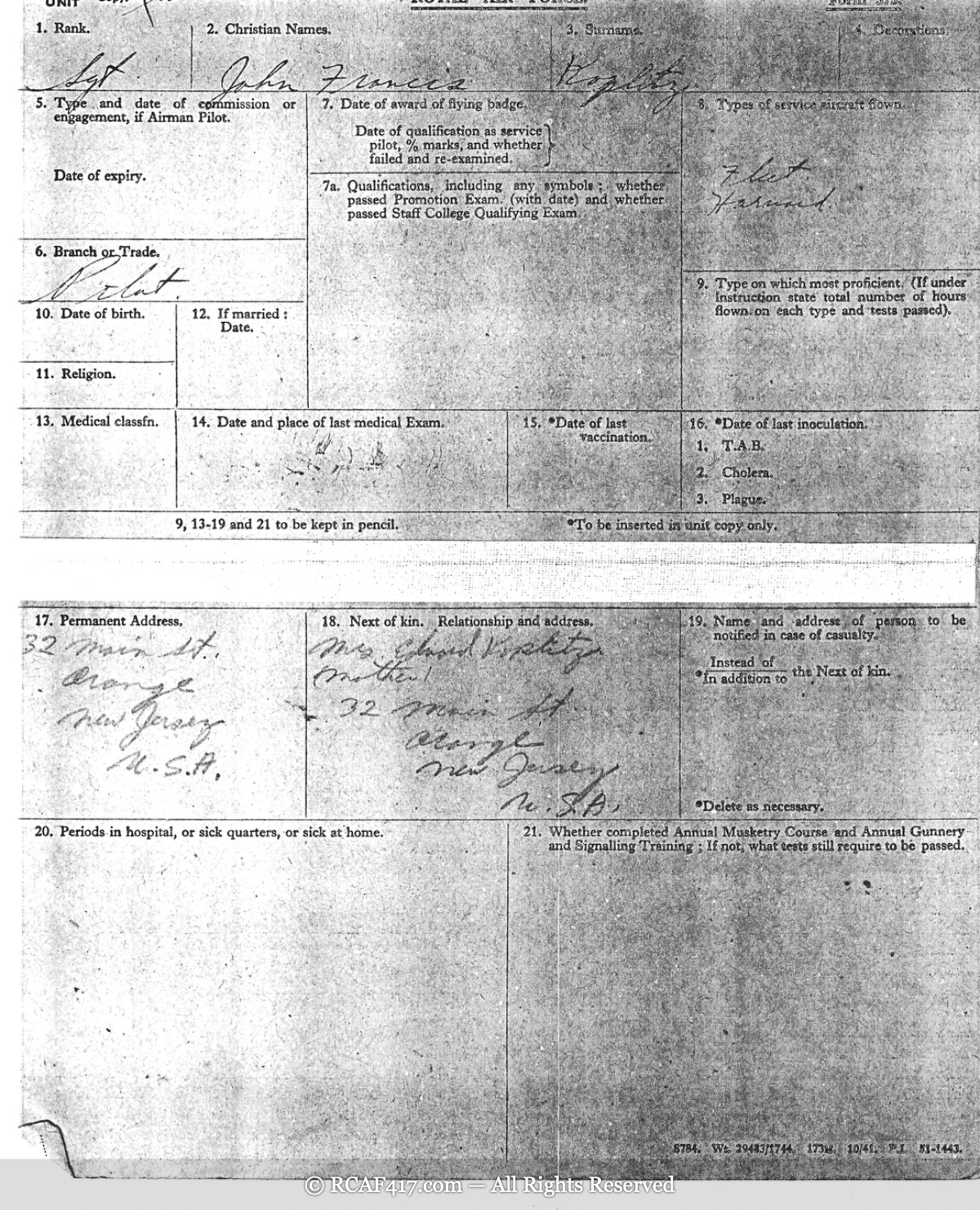
An earlier snapshot of the same card above, filled out while Koplitz still held the rank of
Sergeant — most fields, including his commission, aircraft flown, and hospitalization, are
still blank, and the permanent address given is 32 Main St., Orange, N.J., an earlier family
address than the East Orange one on his later paperwork. Kept together with the fuller card
above, the two amount to a "before and after" of the same official document across his
service.
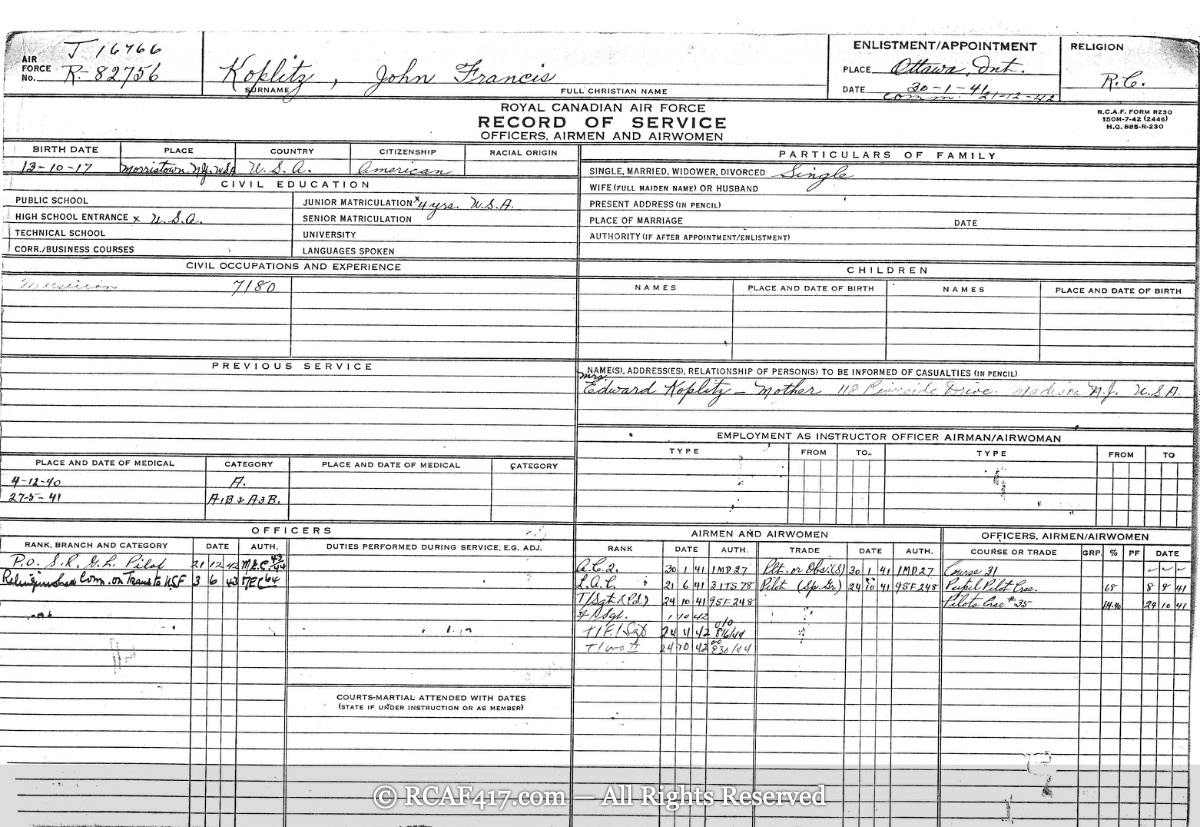
Yet another version of the same underlying record, this one on R.C.A.F. Form R230 —
confirming the family and education details given above and adding little new on this side
of the card, but see the reverse below.
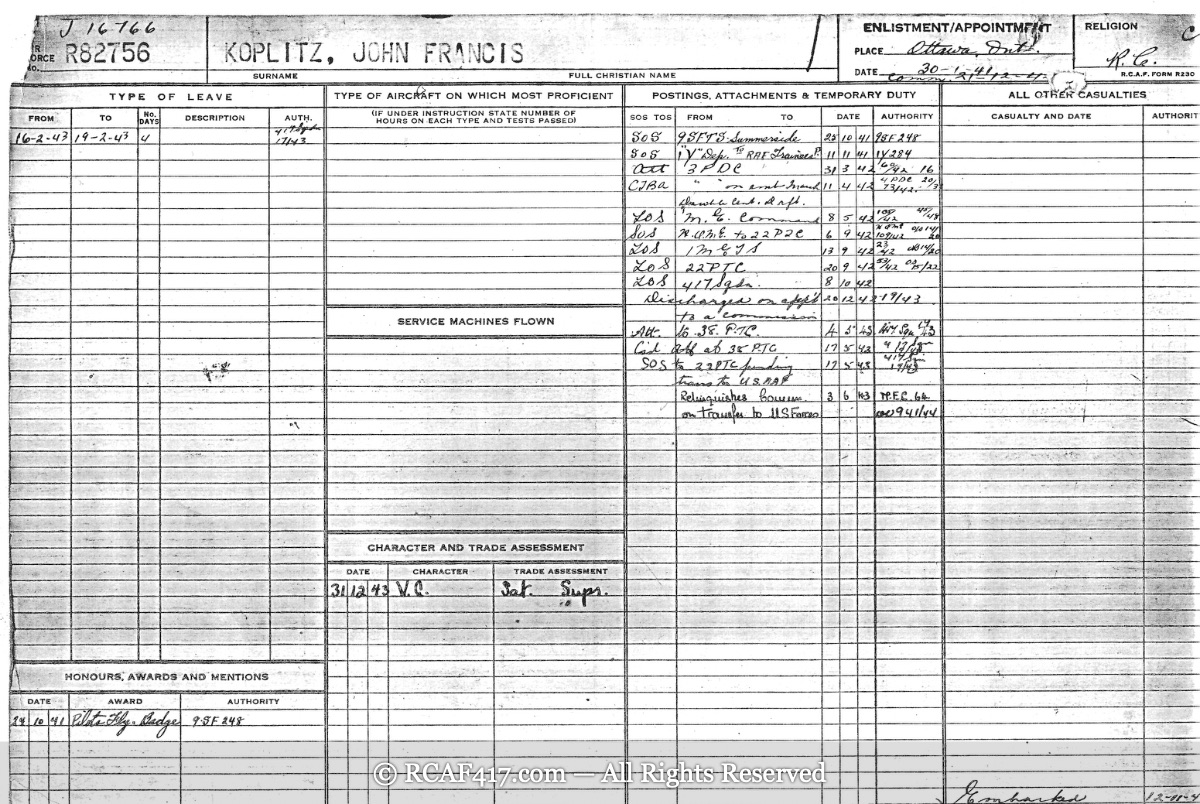
The reverse of the Form R230 card above, recording a period of leave from February 16 to
19, 1943, and the same closing postings seen elsewhere: attachment to 22 P.T.C. pending
transfer to the U.S. Air Force, the entry "Discharged on appointment to a commission"
dated December 20, 1942, and the final note "Relinquishes Commission on transfer to U.S.
Forces," dated June 3, 1943 — matching the Officer Personal Record Card above exactly.
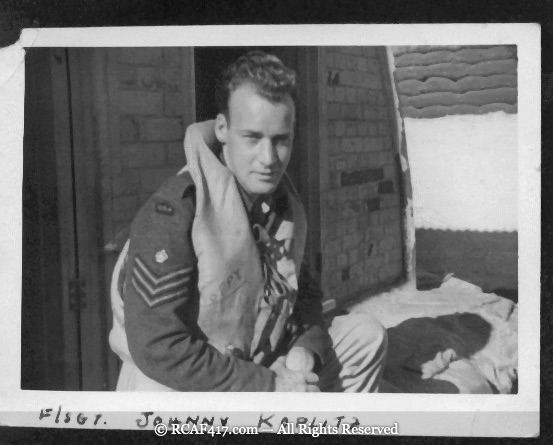
Koplitz during his RCAF training in Canada. This print came from John Riley, who trained
alongside him and mailed it home decades later along with the original negative (see
Riley's February 2001 letter in
Chapter Seven: The Comrades). The photograph is inscribed
in the corner "F/Sgt. Johnny Kaplitz" — Riley's own spelling of the name at the time.
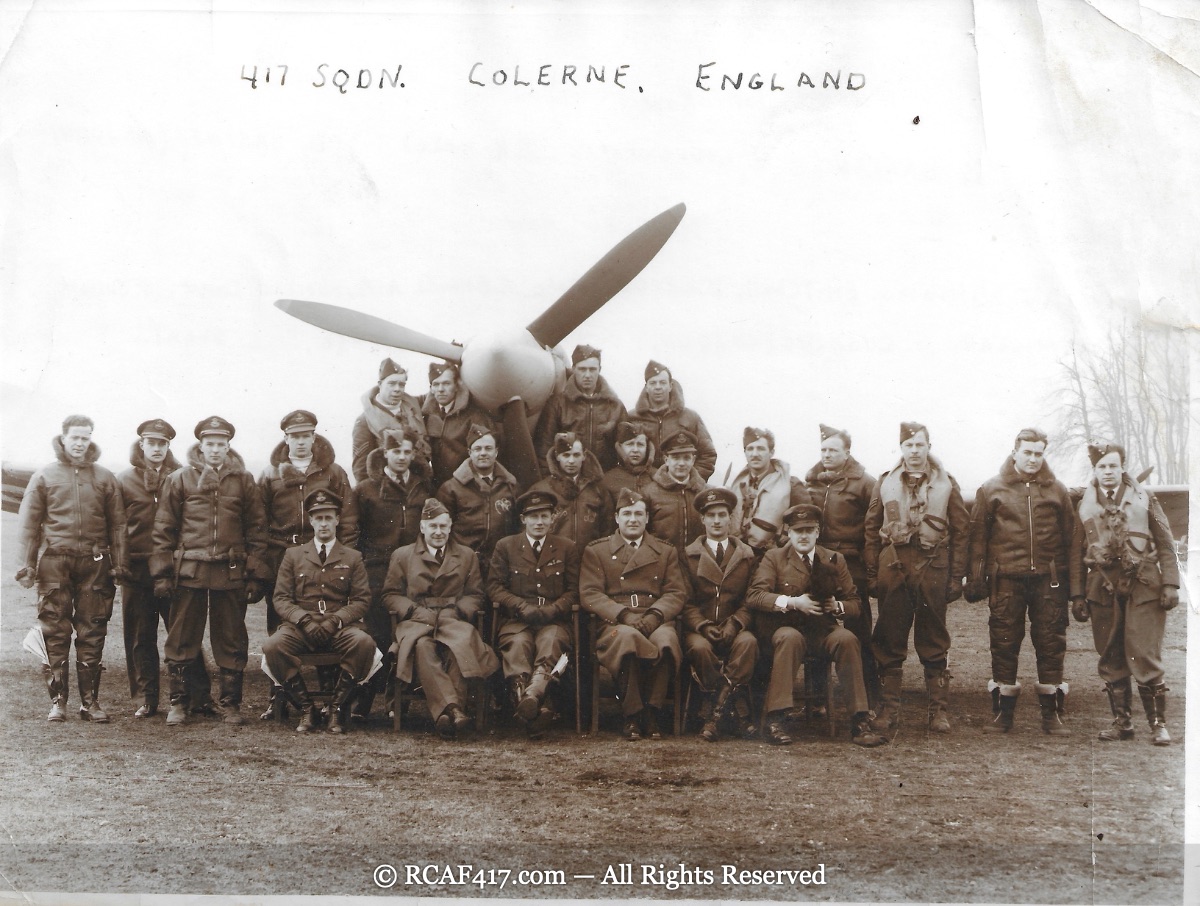
From Canada, Koplitz crossed to England, where 417 Squadron itself had formed. The photograph
below, taken at RAF Colerne, shows the squadron posed in front of a Spitfire just before their
move north to RAF Tain, Scotland — one stop in the squadron's workup before its eventual
deployment to Egypt in April 1942, as the air war in the Western Desert built toward its
decisive phase.
417 Squadron, RAF Colerne, England — taken just before the squadron's move to RAF Tain.
Identified from the back of the photograph: top row — M. Bakkan, G.
LeGuerrier, R. Hazel, D. Hartney (411 Sqdn); middle row — Percival, T.
Williams, E. Mitchell, D. Bruce, K. Pate, R. Brooks, A. Pourbaix, H. Conn, H. Sutton, D.
Millar, G. Cushing (411 Sqdn), J. Maurice, K. Clarke, L. Grant; bottom row
(seated) — F/Lt. Foster, Air Vice Marshal Walker, S/Ldr. Malfroy, G/C Harvey, F/Lt.
Pentland, S/Ldr. Wooten. (A few names above are hard to make out in the original handwriting
and may be refined later.) D. Bruce is very likely the same "P/O Doug Bruce" identified
elsewhere in this archive. Note that two of the men — Hartney and Cushing — are marked as
411 Squadron rather than 417, suggesting this was a joint gathering of both squadrons.
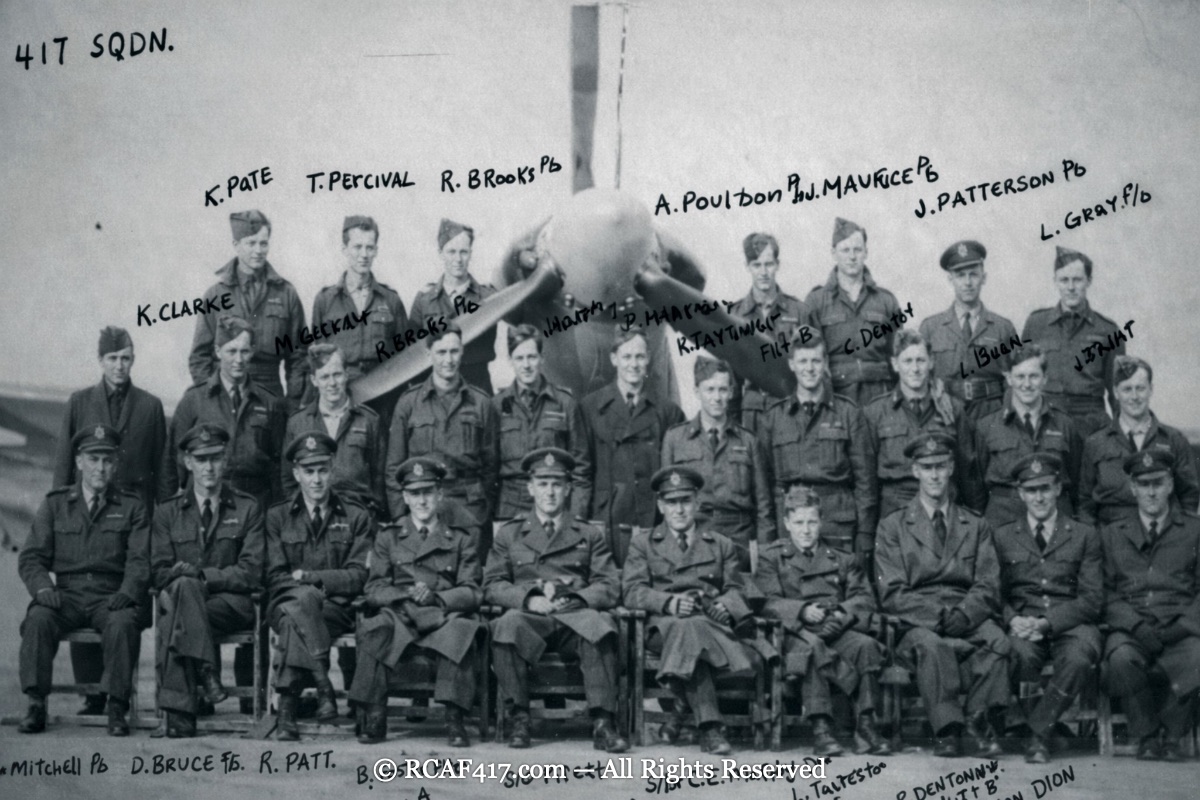
Another 417 Squadron group photograph, labeled "417 SQDN" and annotated directly on the
print with names. Several of the men also appear in the Colerne photograph above — K. Pate,
T. Percival, R. Brooks, K. Clarke, D. Bruce, and J. Maurice — suggesting this was taken
around the same time and place. Others named here don't appear in the Colerne photo:
A. Poulton, J. Patterson, L. Gray, M. Berkaw, C. Denton, L. Buon, and J. Bryant, among a few
more whose names are harder to make out. A row of further names along the bottom edge is
partly cut off in this scan.
By April 1942, training and squadron workup complete, Koplitz deployed overseas to Egypt.